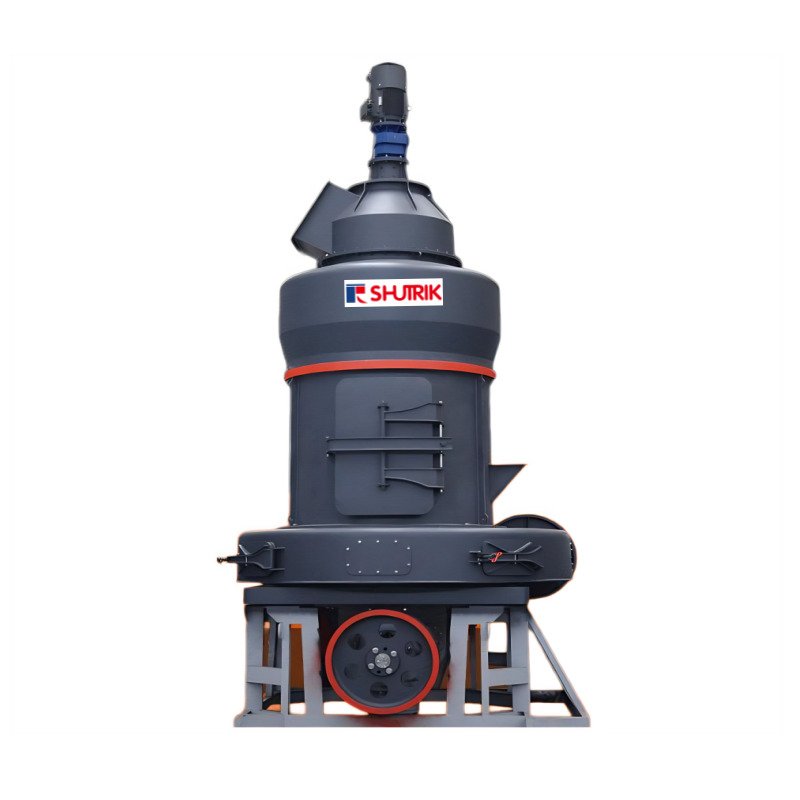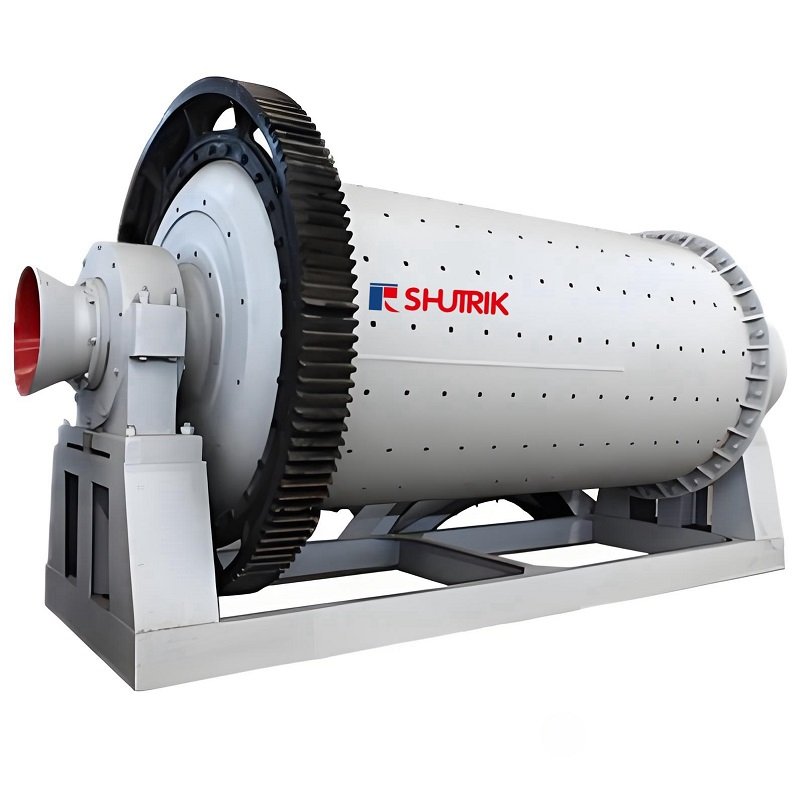
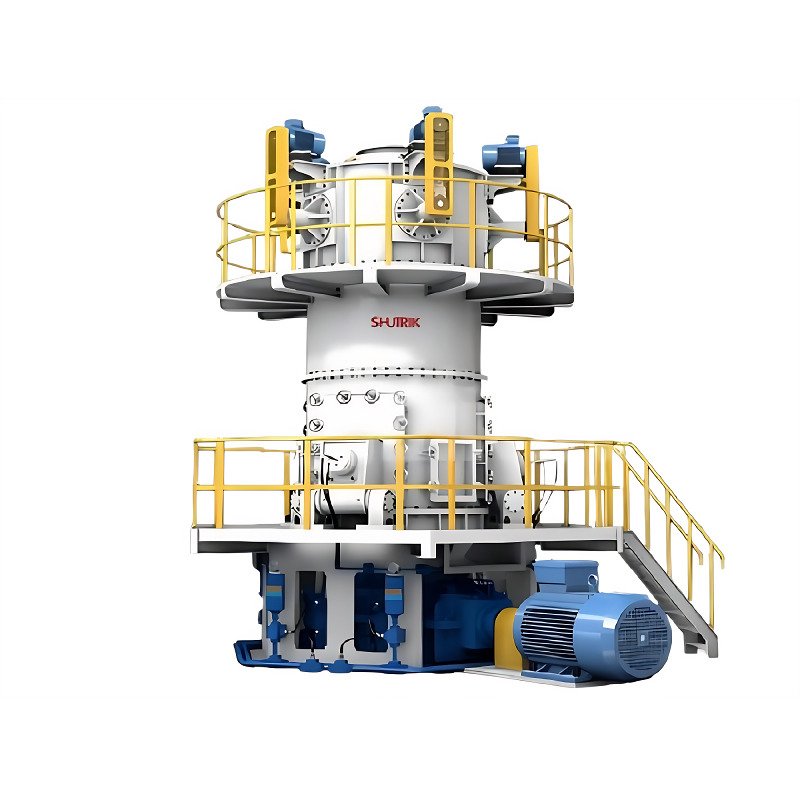
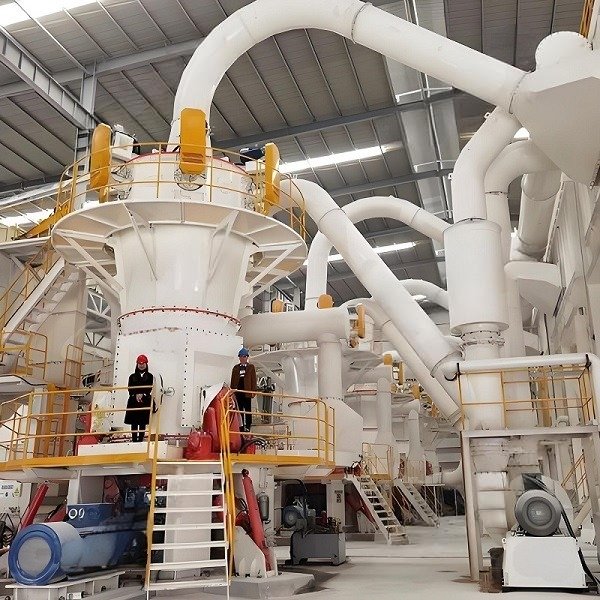
Sandreck‘s industrial vertical grinding mill feeds material (0–55 mm) by applying pressure via grinding rollers onto a rotating grinding table, achieving the desired product fineness.
This equipment offers numerous advantages, including high grinding efficiency, strong drying capability, easily adjustable product fineness, low noise levels, low power consumption, a simplified process flow, minimal wear, and reduced operating costs. It is widely used for the grinding and ultra-fine grinding of various solid materials across industries such as cement, building materials, electric power, metallurgy, chemicals, and non-metallic minerals.

Structure of the China Vertical Grinding Mill
| Grinding System | Classification System | Drying System | Drive System | Hydraulic System |
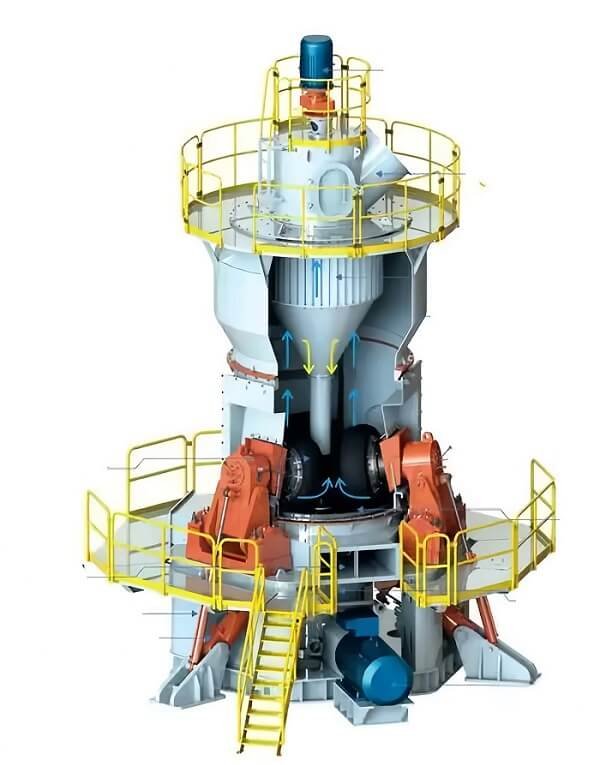
| It consists of a grinding disc, a grinding roller, etc. The grinding roller is located above the grinding disc. | A dynamic classification system in which a high-speed rotating rotor generates a centrifugal force field. | Hot air introduced from the bottom enters the mill via an air ring. | Consists of a main motor and a gearbox. | An independent maintenance hydraulic cylinder facilitates the flipping of roller sleeves for continued use. |
| The hydraulic system applies pressure to the grinding roller for crushing and crushing. | The fineness of the finished product is controlled by adjusting the rotor speed. | It efficiently dries the material while simultaneously conveying it pneumatically. | The main motor provides the primary power, while the gearbox drives the grinding table. | Grinding force is applied via the grinding roller pressurizing cylinder. |
Vertical Grinding Mill Working Principle
1) Material Feeding and Distribution:
Material enters the center of the vertical roller mill through the feed inlet and is evenly distributed across the rotating grinding table. The table is driven by a motor via a gearbox; centrifugal force pushes the material toward the outer edge.
2) Grinding Process:
Grinding rollers (typically 2–6, depending on the model) apply high pressure to the material, driven by a hydraulic or spring system. The material is pulverized through a combination of compression and shear forces. While the rollers rotate on their own axes, they also revolve with the grinding table, maintaining a gap without making direct contact. The material forms a bed within this gap, undergoing further size reduction through inter-particle friction and collision.
3) Airflow Conveying and Drying:
High-speed airflow is discharged from the air ring at the base of the grinding table, conveying the pulverized material upward. This airflow simultaneously performs a drying function, removing moisture from the material and integrating the drying and grinding processes.
4) Classification and Recirculation:
The material is carried by the airflow into the internal separator (classifier). Coarse particles are intercepted by the separator vanes due to inertia and fall back onto the grinding table for regrinding. Fine particles are carried by the airflow into a dust collection system (such as a bag filter or electrostatic precipitator) to be collected as the final product.
5) External Recirculation and Adjustment:
Coarse particles that are not lifted by the airflow, as well as foreign objects (such as metal), fall through the air ring to the bottom of the mill. They are either discharged by scrapers or fed back into the mill via an external recirculation system (such as a bucket elevator). Product fineness and system load can be controlled by adjusting the air ring velocity, hydraulic pressure, and separator speed.
Advantages of Industrial Vertical Grinding Mill
1. Simple system, easy operation and adjustment, and a high degree of automation. Industrial vertical grinding mills are suitable for both large-scale/ultra-large-scale industrial production and small-to-medium-scale operations. Typically equipped with an automatic control system, they allow for remote control and simplify operation and maintenance.
2. High grinding efficiency and significant energy savings. Compared to ball mill systems, vertical grinding mills can save 30%–40% in electricity. Relative to traditional mills, the high external circulation ratio helps reduce system power consumption by approximately 20%.
3. High cost-performance ratio and low investment. The vertical mill integrates crushing, drying, grinding, classifying, and conveying into a single unit. It features a simple process flow, compact structure, and small footprint, and can be installed outdoors.
4. High product fineness. The classifier is manufactured with high precision and offers high separation efficiency, making the China vertical grinding mill particularly suitable for producing ultra-fine powders.
5. Minimal wear and low steel consumption. There is no direct contact between the grinding table and the rollers. The table liners and roller surfaces are made of highly wear-resistant materials, ensuring a long service life.
6. Reliable operation and convenient maintenance. Grinding rollers can be swung out of the mill housing for maintenance. For large models with four rollers, if one roller (or two symmetrically positioned rollers) undergoes maintenance, the remaining two symmetrical rollers can continue to operate, achieving 60%–70% of normal capacity with minimal impact on the overall production line. A modular design facilitates rapid maintenance, ensuring continuous production.
7. Low vibration and noise; dust-free operation under negative pressure. The system is fully sealed and operates under negative pressure, preventing dust leakage.

Vertical Grinding Mill Applications
1. In the cement industry, industrial vertical grinding mills are suitable for grinding cement raw meal. They are also widely used in powder preparation systems across the construction, chemical, and ceramic industries.
2. In the building materials and metallurgical sectors, vertical roller mill machines are suitable for grinding materials such as high-fineness slag powder (from both iron and steel production), manganese ore, and nickel slag.
3. In thermal power plants, vertical grinding mills are utilized for flue gas desulfurization processes.
4. In industries such as metallurgy, chemicals, and mining, vertical mills for sale are suitable for grinding various ores (e.g., iron, copper, phosphate, graphite, quartz) and other industrial solid materials. In the field of non-metallic mineral deep processing, they are widely used for grinding and ultrafine processing of materials such as limestone, calcite, talc, fluorite, barite, gypsum, and bentonite. The product fineness can be controlled between 80 and 3000 mesh (180–5 μm), meeting diverse requirements ranging from coarse to ultrafine powders.
5. In the fields of environmental protection and the circular economy, industrial vertical grinding mills are used to process solid wastes—such as construction debris, steel slag, and industrial slag—into green building materials. They are also employed for the resource recovery and processing of industrial by-products, including limestone powder for power plant desulfurization and ash/residue from solid waste incineration.

Technical Parameters of Vertical Grinding Mill
Mineral ore vertical roller mill (non-metallic minerals, metallic ores, cement raw meal, etc.)
| Specifications | SRM19-2K | SRM22-2K | SRM24-2K | SRM27-2K | SRM27-3K | SRM31-2K | SRM31-3K | SRM34-2K | SRM34-3K | SRM37-3K | SRM39-3K | SRM44-4K | SRM50-4K |
| Capacity (t/h) | 10~40 | 15~50 | 20~70 | 25~85 | 30-90 | 38~135 | 40~145 | 46~160 | 48~170 | 55~196 | 65~220 | 75~260 | 90~400 |
| Max Input Size (mm) | 30 | 30 | 35 | 35 | 35 | 45 | 45 | 45 | 50 | 50 | 50 | 50 | <55 |
| Main Mill Power (KW) | 200~220 | 280~315 | 400~450 | 500~560 | 500~630 | 630~900 | 710~1000 | 800~1120 | 800~1250 | 900~1600 | 1120~1800 | 1800~2200 | 2500~3150 |
| Best Input Moisture | <4% | <4% | <4% | <4% | <4% | <4% | <4% | <4% | <4% | <4% | <4% | <4% | <4% |
| Input Moisture needs Drying | <15% | <15% | <15% | <15% | <15% | <15% | <15% | <15% | <15% | <15% | <15% | <15% | <15% |
| Output Size | 840-37 | 840-37 | 840-37 | 840-37 | 840-37 | 840-37 | 840-37 | 840-37 | 840-37 | 840-37 | 840-37 | 840-37 | 840-37 |
| μm | 20-400 | 20-400 | 20-400 | 20-400 | 20-400 | 20-400 | 20-400 | 20-400 | 20-400 | 20-400 | 20-400 | 20-400 | 20-400 |
| Power Moisture after Drying | ≤1% | ≤1% | ≤1% | ≤1% | ≤1% | ≤1% | ≤1% | ≤1% | ≤1% | ≤1% | ≤1% | ≤1% | ≤1% |
Note. The above capacity is based on grinding brittle material with Mohs hardness < 6 and grindability (Bond) index ≤10KWh/t.
Coal vertical grinding mill (industries like metallurgical blast furnace coal injection, new energy, kiln fuel, thermal boiler coal powder, cement and others)
| Specifications | SRM12-2M | SRM17-2M | SRM19-2M | SRM22-2M | SRM24-2M | SRM27-2M | SRM31-2M | SRM31-3M | SRM34-3M | SRM37-3M |
| Capacity (t/h) | 4~6 | 7~10 | 10~17 | 16~22 | 20~30 | 26~40 | 35~50 | 40~65 | 45~80 | 65~100 |
| Max Input Size (mm) | 38 | 38 | 40 | 40 | 45 | 45 | 50 | 50 | 50 | 50 |
| Main Mill Power (kW) | 55~75 | 110~132 | 185~220 | 250~280 | 315~355 | 400~500 | 500~630 | 560~800 | 710~900 | 900~1250 |
| Coal Input Moisture | <15% | <15% | <15% | <15% | <15% | <15% | <15% | <15% | <15% | <15% |
| Coal Output Size (R0.08) | 10-20% | 10-20% | 10-20% | 10-20% | 10-20% | 10-20% | 10-20% | 10-20% | 10-20% | 10-20% |
| Coal Power Moisture | <1-5% | <1-5% | <1-5% | <1-5% | <1-5% | <1-5% | <1-5% | <1-5% | <1-5% | <1-5% |
Note: The above capacity is based on grinding bitumite, with HGI (Hardgrove Grindability Index) ≥55.
Superfine vertical grinding mill (superfine heavy calcium and other non-metallic minerals, chemical industry, etc)
| Specifications | SRM17-2X | SRM19-2X | SRM22-2X | SRM24-2X | SRM27-2X | SRM34-2X | SRM34-3X |
| Capacity (t/h) | 2-6 | 3-13 | 4-16 | 6-24 | 7-28 | 9-35 | 12-40 |
| Max Input Size (mm) | 10 | 10 | 10 | 15 | 15 | 20 | 20 |
| Max Input Moisture | 4% | 4% | 4% | 4% | 4% | 4% | 4% |
| Output Size (10-40μm) | 90-97% | 90-97% | 90-97% | 90-97% | 90-97% | 90-97% | 90-97% |
Note: The technical data is subject to change without prior notice.
Sand powder vertical grinding mill
| Specifications | SRMM1 9-2Y | SRM22-2Y | SRM24-2Y | SRM27-2Y | SRM27-3Y | SRM31-2Y | SRM31-3Y | SRM34-2Y | SRM34-3Y | SRM37-3Y | SRM39-3Y | SRM44-4Y | SRM50-4Y |
| Throughput(t/h) | 30-80 | 35-120 | 40-150 | 50-200 | 55-220 | 65-250 | 80-300 | 120-450 | 130-500 | 140-550 | 160-600 | 240-700 | 300-900 |
| Max Input Size (mm) | 30 | 30 | 35 | 35 | 35 | 45 | 45 | 45 | 50 | 50 | 50 | 50 | 55 |
| Best Input Moisture | ≤3% | ≤3% | ≤3% | ≤3% | ≤3% | ≤3% | ≤3% | ≤3% | ≤3% | ≤3% | ≤3% | ≤3% | ≤3% |
| Output Size (≤0.08mm) | ≥25% | ≥25% | ≥25% | ≥25% | ≥25% | ≥25% | ≥25% | ≥25% | ≥25% | ≥25% | ≥25% | ≥25% | ≥25% |
| Output Size (≤2mm) | ≥80% | ≥80% | ≥80% | ≥80% | ≥80% | ≥80% | ≥80% | ≥80% | ≥80% | ≥80% | ≥80% | ≥80% | ≥80% |
Note. The above capacity is based on grinding material with a grindability (Bond) index ≤18KWh/t.


Related products
-
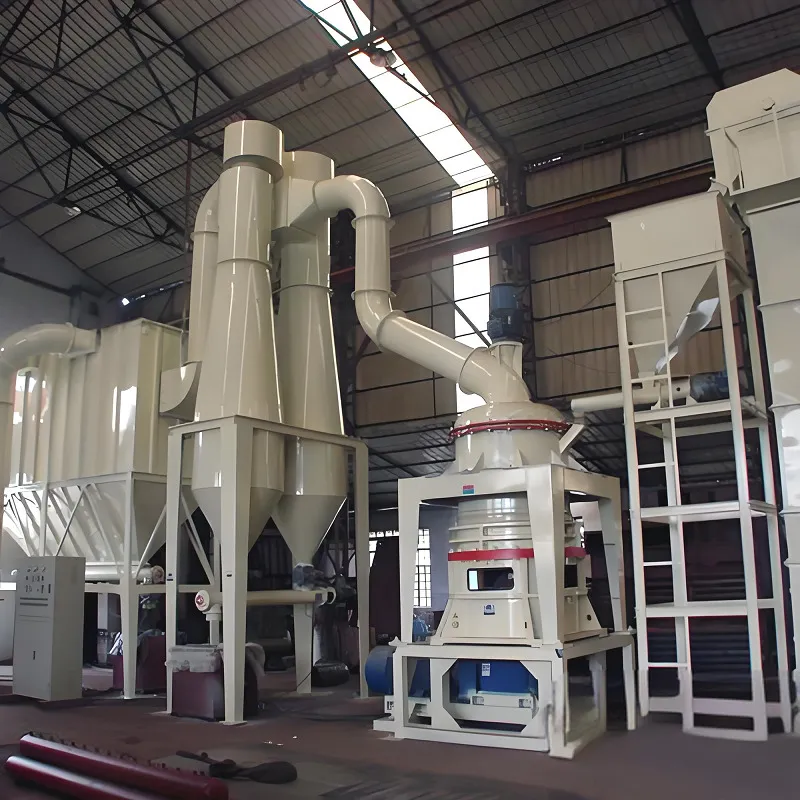
Micro Powder Grinding Mill
The micro powder grinding mill is an advanced piece of equipment designed for the dry, superfine grinding of non-metallic powders. It is widely used in applications such as calcium carbonate pulverization, gypsum powder processing, power plant desulfurization, non-metallic mineral powder production, and pulverized coal preparation. The finished products find extensive application across various sectors, including construction, building materials, glass, ceramics, and the chemical industry.
- Capacity: 0.5 – 25 t/h
- Feed Size: ≤ 20 mm
- Output Size: 325 – 3250 mesh
-
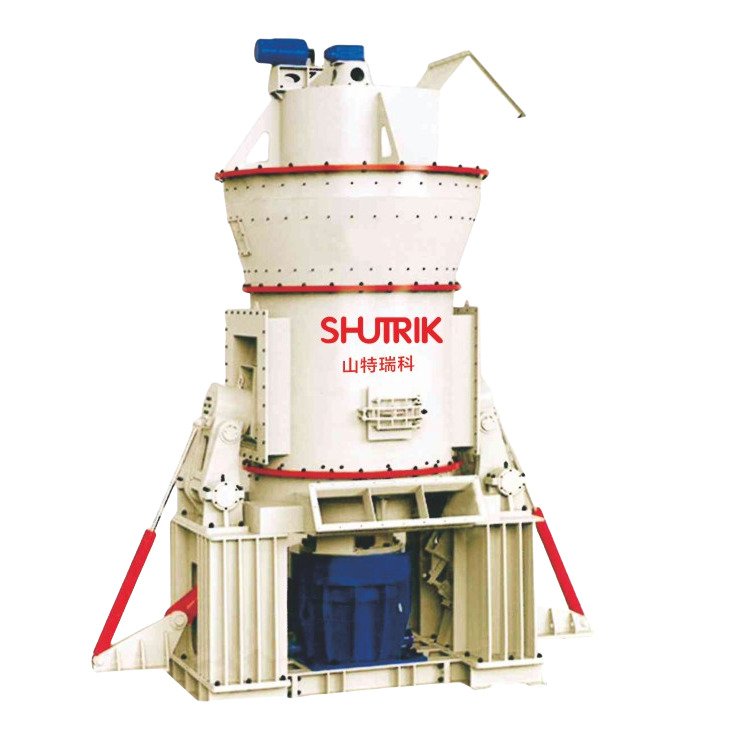
Vertical Roller Mill Machine
The vertical roller mill machine is a high-efficiency grinding machine that integrates crushing, grinding, drying, classifying, and conveying. Its core principle is based on material bed grinding technology, achieving material pulverization through the relative motion between grinding rollers and the grinding table.
- Capacity: 10 – 400 t/h
- Feed Size: ≤ 55 mm
- Output Size: 20 – 400 mesh
-
Grinding Rod Mill
Grinding rod mills are primarily utilized in the first stage of open-circuit grinding for coarse- to fine-size reduction. They are particularly well-suited for brittle ore materials. Our rod mills offer the advantages of uniform product particle size and high throughput.
- Capacity: 100-500 t/h
- Feed Size: <25 mm
- Output Size: 0.074-5 mm
-
Rod Mill Equipment
Rod mill equipment is primarily used for coarse grinding operations. They are suitable for the fine crushing and coarse grinding of ores and are particularly well-suited for processing brittle materials. They are widely used in the production of manufactured sand, as well as in mineral processing plants, chemical plants, and the power industry.
- Capacity: 100-500 t/h
- Feed Size: <25 mm
- Output Size: 0.074-5 mm
-
Raymond Grinding Mill
The Raymond grinding mill is a type of dry-grinding suspended-roller mill. It is widely used in the non-metallic mining industry and is capable of grinding rock into fine powder.
- Capacity: 0.25-22 t/h
- Feed Size: ≤35 mm
- Output Size: 0.005-0.613 mm
-
Raymond Roller Mill
The Raymond roller mill is a high-efficiency grinding machine featuring a vertical structure. It is primarily used for processing non-metallic minerals into fine and ultrafine powders and is widely applied in industries such as mining, construction materials, chemicals, and metallurgy.
- Capacity: 0.25-22 t/h
- Feed Size: ≤35 mm
- Output Size: 0.005-0.613 mm