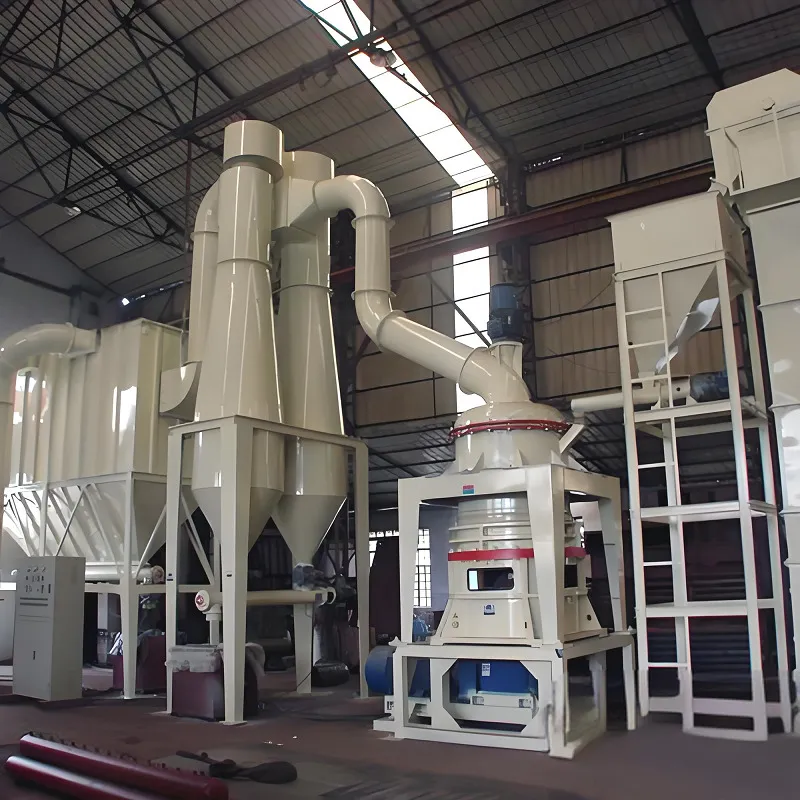

The Raymond grinding roller mill is adept at processing non-flammable and non-explosive ores with a Mohs hardness of 7 or less and a moisture content below 6%. Suitable materials include limestone, marble, calcite, potash feldspar, barite, dolomite, maifan stone, granite, bentonite, kaolin, bauxite, gypsum, talc, fluorite, coal cinder, iron oxide red, and iron ore. It delivers efficient grinding performance and allows for flexible adjustment of the finished product’s particle size, ranging from 80 to 325 mesh.
The equipment accepts a maximum feed size of 35 mm, achieving a 325-mesh pass rate of ≥95% with uniform particle size distribution. Its production capacity ranges from 15 to 22 tons per hour. Sandreck offers extensive customization capabilities, tailoring Raymond mills to meet specific customer requirements.
Structure of Raymond Grinding Roller Mill
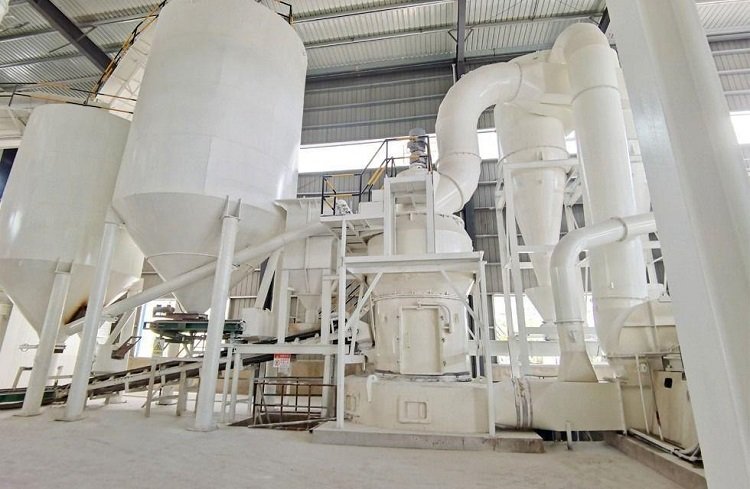
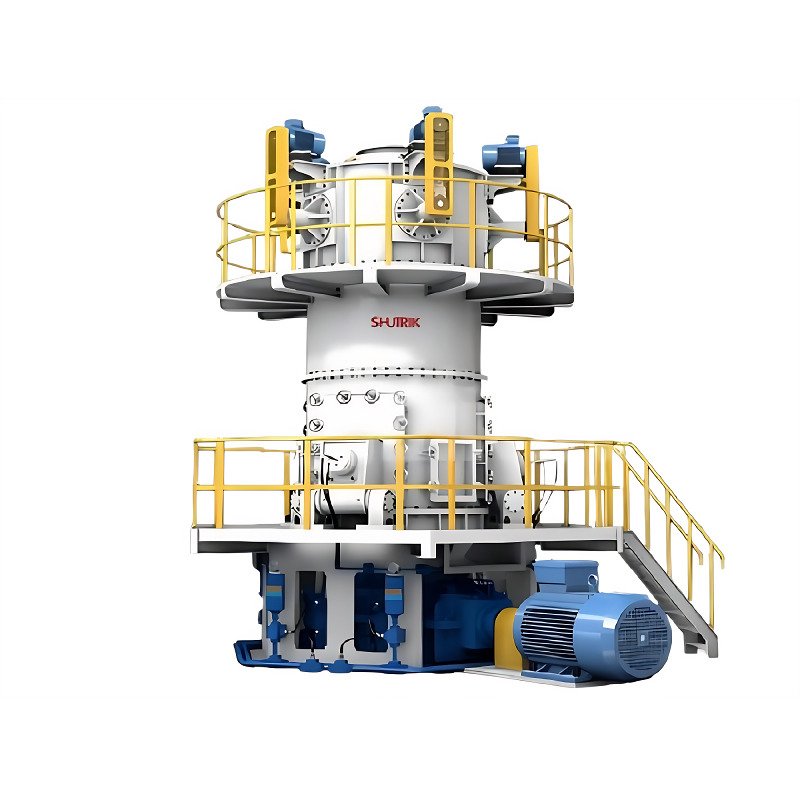
The Raymond roller mill primarily consists of a main unit, a classifier, a blower, a finished product cyclone separator, a fine powder cyclone separator, and air ducts. The specific structure is as follows:
- Main unit: Comprises components such as grinding rollers, grinding rings, blades, a central shaft, and a support frame. The grinding rollers and rings are the core components responsible for crushing and grinding the material.
- Classifier: Used to control the fineness of the finished product. The particle size can be regulated by adjusting the classifier’s rotational speed.
- Blower: Generates airflow to transport the ground material to the cyclone separators.
- Cyclone separator: Separates fine powder from the airflow and collects it as the finished product.
- Fine powder cyclone separator: Further separates fine powder to enhance the fineness of the finished product.
- Air ducts: Connect the various components and facilitate airflow transport.
Raymond Roller Mill Working Principle
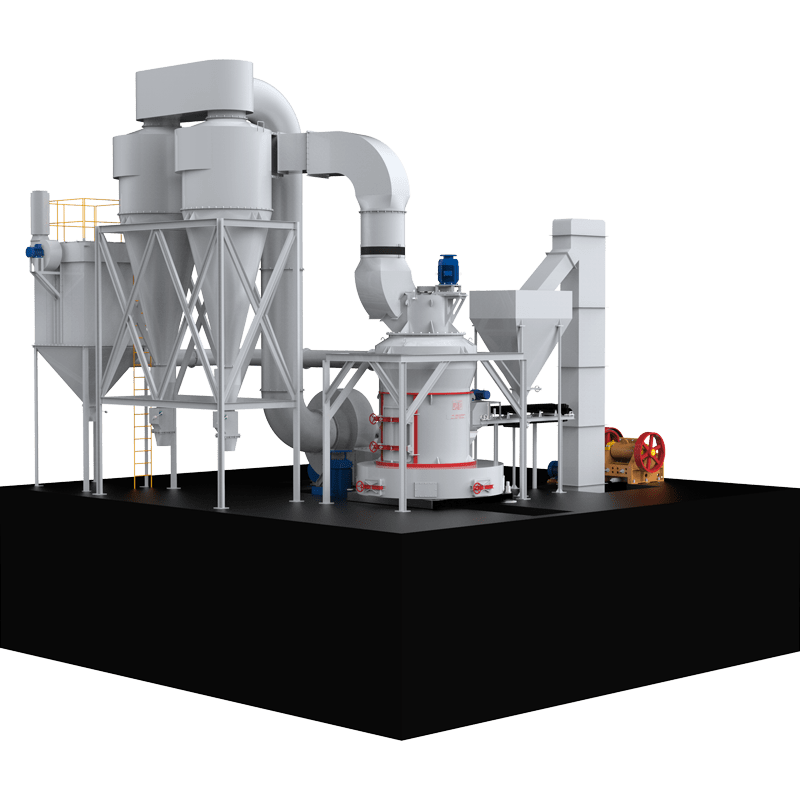
The operation of the Raymond grinding roller mill can be broken down into the following steps:
- Material Feeding: Material enters the center of the main unit via the feeding device and lands in the middle of the rotating grinding ring. Driven by the central shaft, the grinding rollers rotate around the grinding ring, squeezing and grinding the material.
- Grinding Process: The gap between the grinding rollers and the grinding ring is very narrow. Under the squeezing and grinding action of the rollers, the material is gradually pulverized into fine powder. Scovels continuously scoop up the material and distribute it evenly across the grinding ring to ensure thorough grinding.
- Airflow Conveying: A high-speed airflow generated by the blower carries the ground material out of the main unit and into the classifier. The classifier rotates at high speed to separate fine powder from coarse particles. The fine powder passes through the classifier into the finished product cyclone separator, while the coarse particles return to the main unit for further grinding.
- Finished Product Collection: Fine powder is separated from the airflow in the finished product cyclone separator and collected as the final product. A secondary cyclone separator further extracts even finer powder to enhance the product’s fineness. Any unseparated fine powder is returned to the main unit via air ducts to undergo further grinding.
- Circulation Process: The operation of the Raymond mill is a continuous cycle. Material circulates repeatedly between the main unit, the classifier, and the cyclone separators until the desired fineness is achieved. The rotational speed of the classifier and the airflow volume of the blower can be adjusted to control the fineness and output of the finished product.

Advantages of Raymond Grinding Roller Mill
- Compact Design: Features a vertical structure that is simple in design and has a small footprint—requiring over 50% less space than a ball mill.
- High Efficiency and Energy Saving: Utilizes a dual-cyclone collector design, increasing collection efficiency by 10%–15% compared to single-cyclone systems. Overall energy consumption is 30%–40% lower than that of a ball mill.
- Precise Control: Offers precise control over the finished powder (ranging from 80 to 400 mesh), ensuring stable output and uniform particle size; the pass rate for 325 mesh is ≥95%.
- Eco-friendly: Employs a sealed, negative-pressure design to effectively suppress noise and dust leakage. Equipped with a two-stage dust collection system, ensuring exhaust emissions remain ≤10 mg/m³.
- Wear-resistant and Cost-effective: Grinding rollers and rings are made from wear-resistant materials such as ZGMn13 high-manganese steel or alloy steel. The Raymond roller mill equipment purchase cost is only one-third that of a standard vertical mill.

Raymond Roller Mill Applications
Raymond roller mills for sale are widely used in industries such as non-metallic minerals, chemicals, construction materials, metallurgy, and food processing for efficient powder production and ultrafine powder processing.
- Mineral Processing: Grinding of non-flammable and non-explosive minerals—such as quartz, talc, marble, limestone, dolomite, gypsum, graphite, manganese ore, titanium ore, copper ore, and chrome ore—with a Mohs hardness of ≤9.3 and moisture content of ≤6%.
- Chemicals and Fertilizers: Ultrafine powder processing of chemical raw materials such as activated bleaching earth, activated carbon, bentonite, kaolin, iron oxide, and titanium dioxide.
- Construction Materials Industry: Pulverization and fine grinding of raw materials such as cement, refractory materials, thermal insulation materials, and clay.
- Food and Pharmaceuticals: Grinding and processing of certain food additives and pharmaceutical powders.
- Other Industries: Meeting the demand for ultrafine powders in sectors such as coatings, abrasives, and glass manufacturing.

Technical Parameters of Raymond Grinding Roller Mill
| Mode | Roller Number | Roller Size (mm) | Max Feed Size(mm) | Fineness of Powder(mm) | Output(t/h) | Motor Power (kW) | Blower Power (kW) | Overall Dimension(mm) |
| QBM4528 (QBM160) | 6 | 450×280 | 15-35 | 0.613-0.044 | 5-22 | 132 | 132 | 12500x5700x8300 |
| QBM4121 (5R4119) | 5 | 410×210 | 15-25 | 0.613-0.044 | 4-10 | 75 | 75 | 7850x8000x9700 |
| QBM9517 (4R3216) | 4 | 310×170 | 15-25 | 0.025-0.005 | 1.5-8 | 37 | 30 | 7100x5900x7900 |
| QBM3016 | 3 | 300×160 | 15-20 | 0.025-0.005 | 0.35-4 | 22 | 18.5 | 5300x4100x5200 |
| QBM8314 (3R2715) | 3 | 270×140 | 15-20 | 0.025-0.005 | 0.35-3.4 | 22 | 18.5 | 5300x4100x5200 |
| QBM7815 (3R2615) | 3 | 260×150 | 15-20 | 0.025-0.005 | 0.28-3 | 18.5 | 15 | 4300x3500x5100 |
| QBM6515 (3R2115) | 3 | 210×150 | 12-20 | 0.613-0.033 | 0.25-2 | 15 | 11 | 4100x3800x 4500 |



Related products
-
Ultrafine Grinding Mill
Ultrafine grinding mills are pulverizing machines designed to produce ultrafine powders. They are primarily used in industries such as non-metallic minerals, chemicals, construction materials, and coatings. These grinding mills can process minerals—including limestone, calcite, marble, heavy calcium carbonate, pyrophyllite, and talc—into ultrafine powder.
- Capacity: 3 – 25 t/h
- Feed Size: ≤ 15 mm
- Output Size: 300 – 3000 mesh
-
Vertical Roller Mill Machine
The vertical roller mill machine is a high-efficiency grinding machine that integrates crushing, grinding, drying, classifying, and conveying. Its core principle is based on material bed grinding technology, achieving material pulverization through the relative motion between grinding rollers and the grinding table.
- Capacity: 10 – 400 t/h
- Feed Size: ≤ 55 mm
- Output Size: 20 – 400 mesh
-
Vertical Grinding Mill
The vertical grinding mill integrates the functions of fine crushing, grinding, drying, classifying, and conveying. The system is simple, easy to operate and adjust, and features a high degree of automation. It is suitable for both large-scale and ultra-large-scale industrial production, as well as for small- and medium-scale operations.
- Capacity: 10 – 400 t/h
- Feed Size: ≤ 55 mm
- Output Size: 20 – 400 mesh
-
Industrial Ball Mill
The industrial ball mill is a grinding device widely used in industries such as mining, building materials, and chemicals, primarily employed for the crushing, grinding, and mixing of materials, as well as the production of ultrafine powders.
- Capacity: 0.65-130 t/h
- Feed Size: ≤ 25 mm
- Output Size: 0.074-0.89 mm
-
Ball Grinding Mill
A ball mill grinder is a grinding machine that uses steel balls as the grinding medium. It can crush and grind materials to a fineness of 35 mesh or finer and is suitable for use in open-circuit or closed-circuit grinding processes.
- Capacity: 0.65-130 t/h
- Feed Size: ≤ 25 mm
- Output Size: 0.074-0.89 mm
-
Grinding Rod Mill
Grinding rod mills are primarily utilized in the first stage of open-circuit grinding for coarse- to fine-size reduction. They are particularly well-suited for brittle ore materials. Our rod mills offer the advantages of uniform product particle size and high throughput.
- Capacity: 100-500 t/h
- Feed Size: <25 mm
- Output Size: 0.074-5 mm