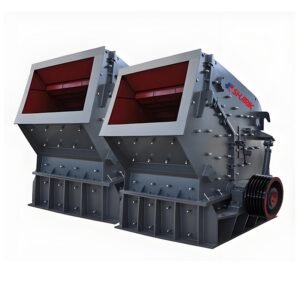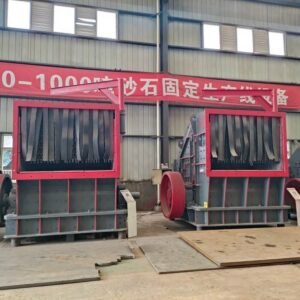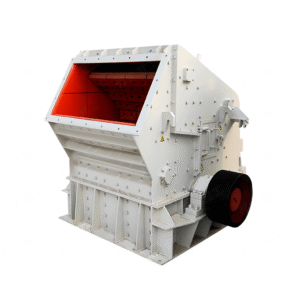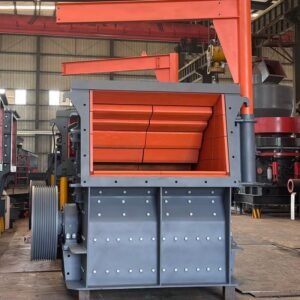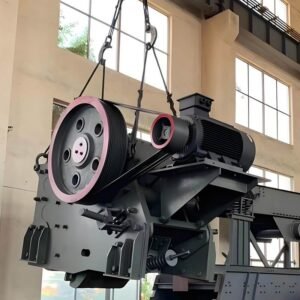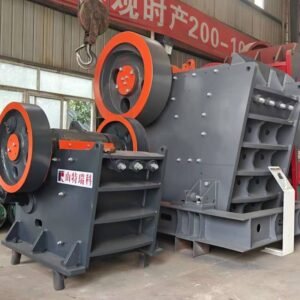
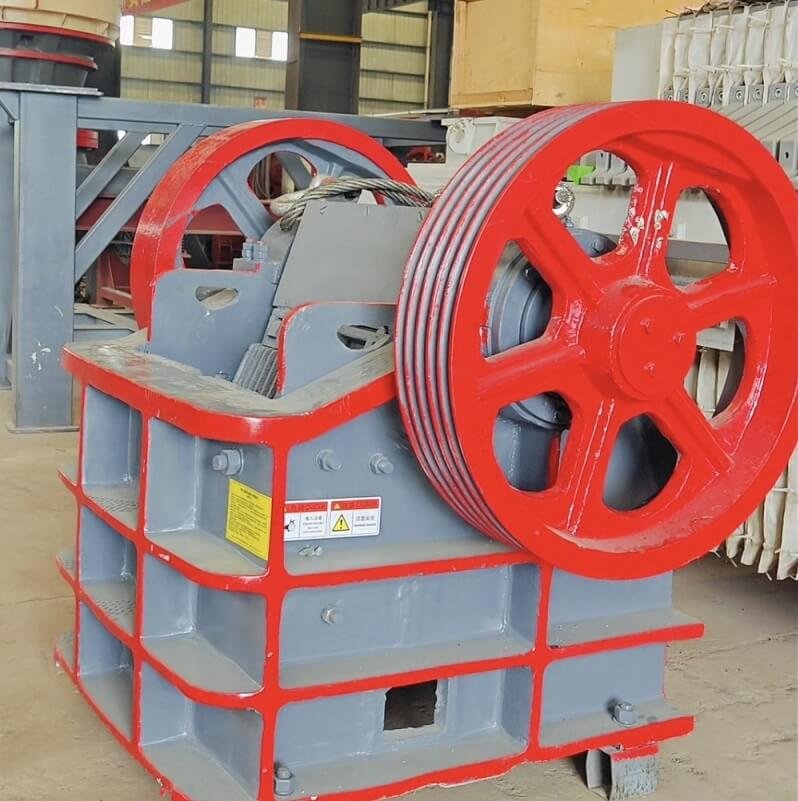
The PE series jaw crusher is primarily used for primary (coarse) crushing of various ores and large materials. It can crush materials with a compressive strength of up to 320 MPa. Frequently employed as a primary crusher, it is a staple in stone and ore crushing production lines. The stone crushing equipment is characterized by a high crushing ratio, high output, uniform product granularity, reliable operation, ease of maintenance, and low operating costs.
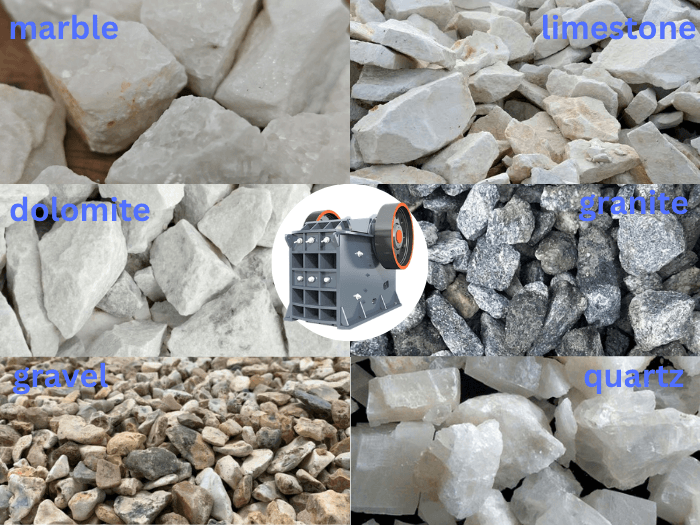
The PE jaw crusher accommodates a maximum feed size of 1200 mm and offers a production capacity ranging from 5 to 1000 tons per hour. As a standard piece of primary crushing equipment, the PE series jaw crusher is widely used across industries such as mining, metallurgy, construction materials, highways, railways, water conservancy, and chemicals. It is suitable for crushing materials including granite, marble, basalt, limestone, quartz, river pebbles, iron ore, and copper ore.
PE Jaw Crusher Working Principle
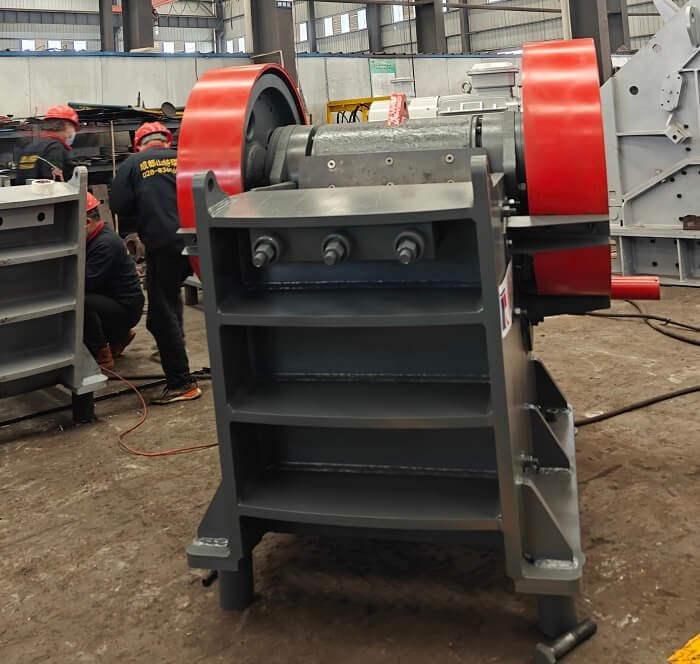
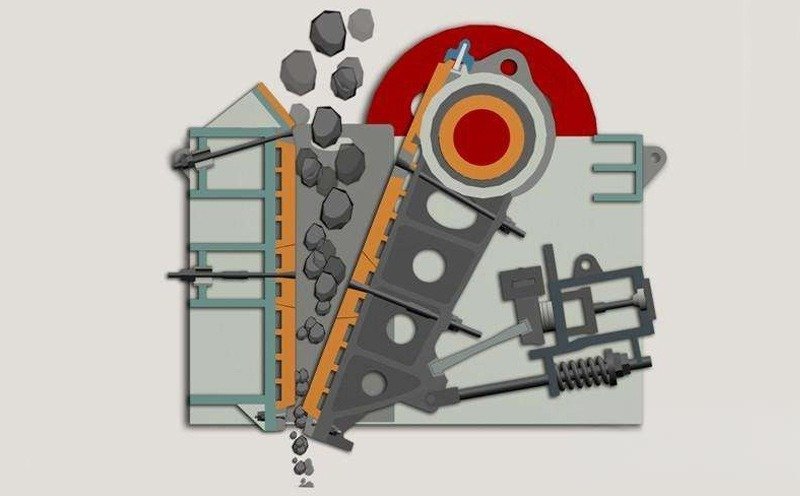
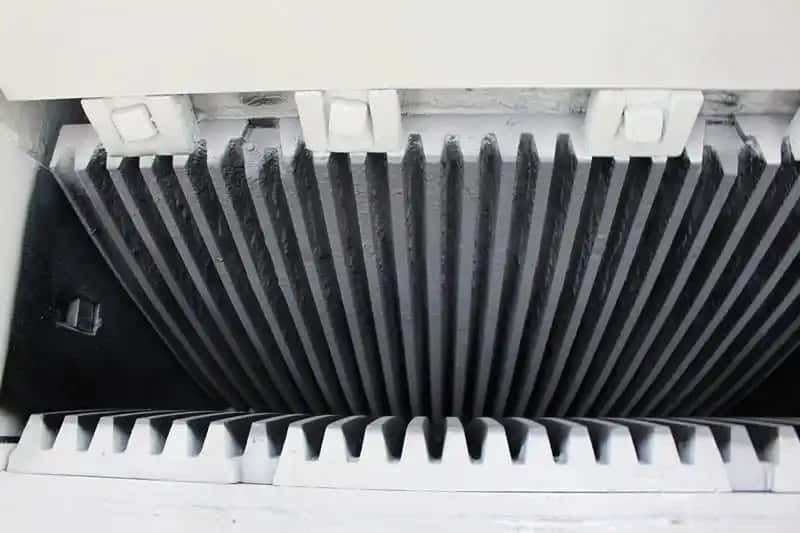
The structure of the PE series jaw crusher primarily consists of a frame, eccentric shaft, large pulley, flywheel, swing jaw, side liners, toggle plate, toggle seat, gap adjustment screw, return spring, and both fixed and movable jaw plates. Notably, the toggle plate also serves a safety function.
The PE jaw rock crusher operates on a compression principle driven by a linkage mechanism. An electric motor drives the belt and pulley, causing the swing jaw to move up and down via the eccentric shaft. As the swing jaw rises, the angle between the toggle plate and the swing jaw increases, pushing the movable jaw plate toward the fixed jaw plate. During this process, the material undergoes multiple crushing actions, including squeezing, rubbing, and grinding.
When the swing jaw descends, the angle between the toggle plate and the swing jaw decreases. Under the action of the tension rod and spring, the movable jaw plate moves away from the fixed jaw plate, allowing the crushed material to discharge from the bottom of the crushing chamber. As the motor continues to rotate, the swing jaw performs periodic crushing and discharging cycles, enabling continuous, high-volume production.
Features of PE Series Jaw Crusher
1. The deep crushing chamber eliminates dead zones, enhancing feed capacity and output.
2. It offers a high crushing ratio and produces material with uniform particle size.
3. The shim-based discharge opening adjustment system is reliable, convenient, and offers a wide adjustment range, increasing equipment flexibility.
4. The lubrication system is reliable, components are easy to replace, and maintenance requirements are minimal.
5. Simple structure, reliable operation, and low operating costs.
6. Energy-efficient: saves 15%–30% of energy per unit.
7. Wide adjustment range for the discharge opening meets diverse user requirements.
8. Low noise and minimal dust generation.
PE Jaw Crusher Application
The PE series jaw crusher is primarily used for primary (coarse) crushing of large materials in the mining and construction industries. It reduces large stones into smaller pieces through the squeezing action of two jaw plates.
1) Key Application Industries
- Mining: Crushing run-of-mine ores such as iron ore and copper ore.
- Building Materials: Processing limestone, raw materials for cement, etc.
- Infrastructure: Production of sand and gravel aggregates for highways, railways, and water conservancy projects.
- Chemical Industry: Crushing quartz sand and other chemical raw materials.
2) Suitable Materials
- Compressive Strength: Suitable for materials of medium to high hardness, with a compressive strength not exceeding 320 MPa (megapascals, a measure of a material’s resistance to crushing).
- Common Materials: River pebbles, limestone, granite, basalt, etc.
3) Position in the Production Line
- Preferred Choice for Primary Crushing: A PE jaw crusher is typically positioned at the beginning of a stone production line, handling the initial crushing of large materials.
- Integration: After primary crushing, the material is conveyed to a secondary/fine crusher (such as the PEX series) for further processing.
Technical Parameters of PE Series Jaw Crusher
| Model | Feeding Size (mm) | Max. Feeding
Size (mm) |
Adjusting Range of
Discharge Opening (mm) |
Capacity(t/h) | Motor Power(kw) | Overall Dimension
(LxWxH)(mm) |
| PE-250X400 | 250*400 | 200 | 20-50 | 5-20 | 15 | 1430x1310x1340 |
| PE-400×600 | 400×600 | 350 | 40-100 | 15-60 | 30-37 | 1700×1732*1653 |
| PE-500×750 | 500×750 | 425 | 50-100 | 40-110 | 45-55 | 1950×1878*1855 |
| PE-600×900 | 600×900 | 480 | 65-160 | 90-180 | 75-90 | 2200x2008x1855 |
| PE-750×1060 | 750×1060 | 630 | 80-140 | 110-320 | 90-110 | 2624x2302x3110 |
| PE-900×1200 | 900×1200 | 750 | 95-180 | 220-450 | 132-160 | 3550x2823x3196 |
| PE-1000×1200 | 1000*1200 | 850 | 95-190 | 400-800 | 160-220 | 3800×3166*3045 |
| PE-1200×1500 | 1200*1500 | 1020 | 150-300 | 450-1000 | 220 | 4930x3148x3703 |
| PE-1500×1800 | 1500×1800 | 1200 | 220-350 | 400-1000 | 355 | 5630*3210×4120 |
相关产品
-
PF Series Impact Crusher
The PF series impact crusher can crush various medium and fine materials (granite, limestone, concrete, etc.) with a feed particle size not exceeding 900mm and a compressive strength not exceeding 350MPa. It features a large crushing ratio, high crushing efficiency, and convenient maintenance.
- Capacity: 90-800 t/h
- Feed Size: <300-900 mm
- Output Size: 20-80 mm
-
Secondary Impact Crusher
A secondary impact crusher is a stone crushing machine that uses impact energy to crush stone. It can process materials with side lengths of 300-900 mm. The finished product is cubic in shape, and the particle size is adjustable.
- Capacity: 90-800 t/h
- Feed Size: <300-900 mm
- Output Size: 20-80 mm
-
Impact Stone Crusher
Stone impact crushers can be used for secondary and tertiary crushing (medium and fine crushing) operations. They are suitable for various soft to medium-hard materials, such as granite, concrete blocks, basalt, and limestone. They feature a simple structure, reliable performance, and a compact footprint, all at a relatively affordable price.
- Capacity: 90-800 t/h
- Feed Size: <900 mm
- Output Size: 10-80 mm
-
Impact Rock Crusher
Rock impact crushers are primarily used in industries such as mining, construction, chemicals, electric power, and metallurgy. They are suitable for crushing ores with a compressive strength of up to 350 MPa, as well as limestone, slag, coke, and coal. This machine is not suitable for crushing ores with a surface moisture content exceeding 8–10% or for processing sticky materials.
- Capacity: 90-800 t/h
- Feed Size: <900 mm
- Output Size: 10-80 mm
-
Jaw Stone Crusher
The jaw stone crusher is a core piece of equipment used for the primary and secondary crushing of medium-hard materials. It crushes various ores and large stone blocks—such as river pebbles, granite, and construction waste—with compressive strengths ranging from 147 to 245 MPa.
- Capacity: 5-1000t/h
- Feed Size: ≤ 1200mm
- Output Size: 20-350 mm
-
Jaw Rock Crusher
The jaw rock crusher is a heavy-duty crushing equipment widely used in industries such as mining, metallurgy, construction materials, and chemicals. It is specifically designed for primary and secondary crushing of high-hardness materials.
- Capacity: 1-1000 t/h
- Feed Size: ≤1200 mm
- Output Size: 10-350 mm