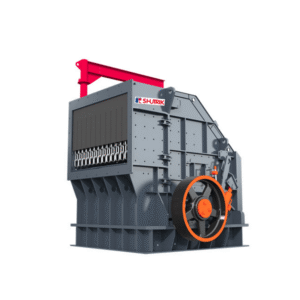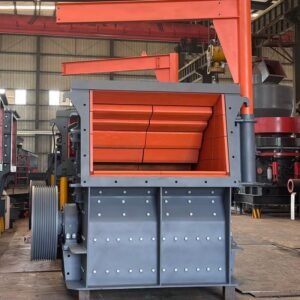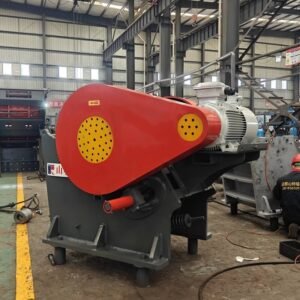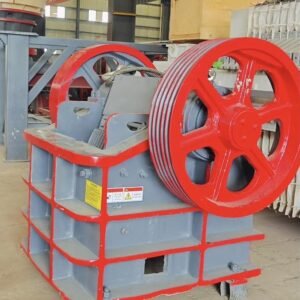
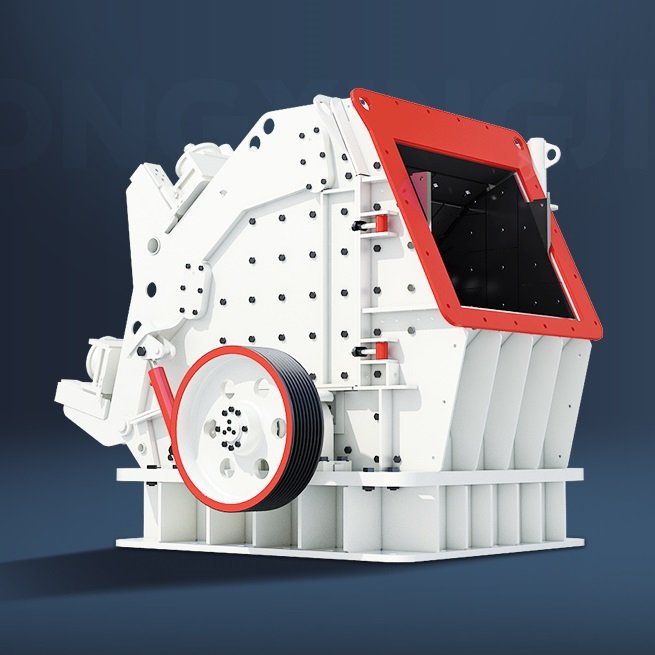
The heavy-duty rotor impact crusher utilizes new, highly wear-resistant materials. The finished product is cubic in shape, free of internal stress and cracks, and boasts excellent particle morphology. The discharge size is adjustable, allowing for diverse crushing specifications. It delivers outstanding performance in applications involving medium-hardness, low-abrasivity materials across sectors such as quarrying, gravel processing, cement, concrete and asphalt recycling, and slag recycling.
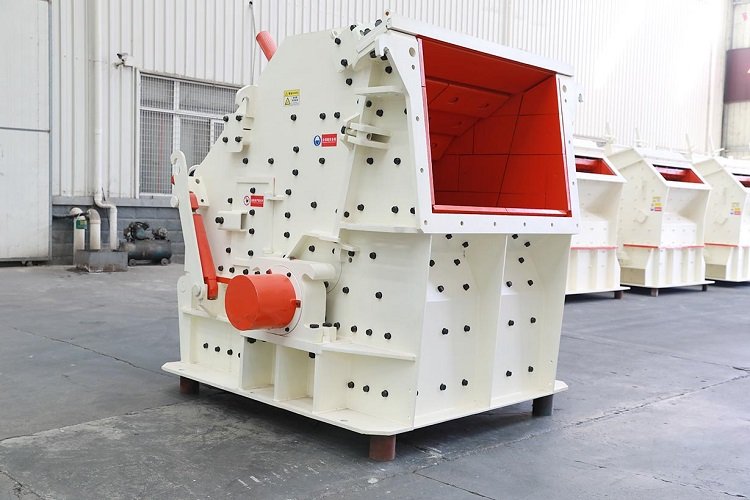
Heavy‑duty Rotor Impact Crusher Working Principle
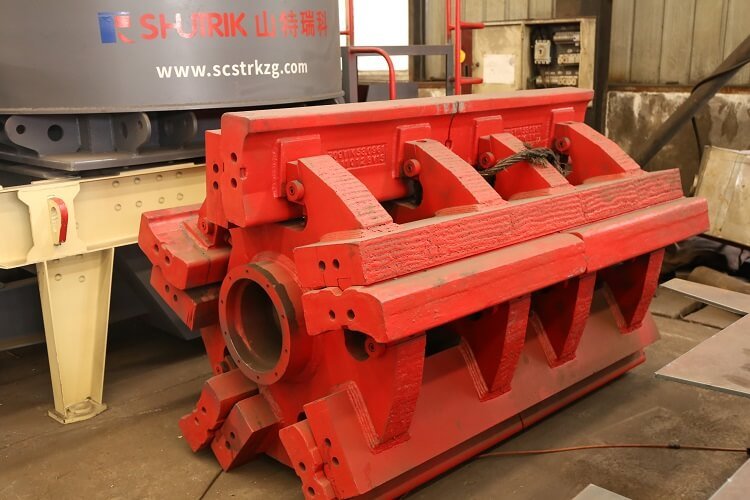
The heavy-duty rotor impact crusher is a piece of equipment designed for primary and secondary crushing that utilizes impact energy to break down materials. It is primarily composed of core components such as the rotor assembly, hammers, first and second impact racks, impact liners, wear liners, tie rods, the main shaft, and the base.
During operation, the motor drives the main shaft via a pulley, causing the rotor assembly to rotate at high speed within the crushing chamber. Consequently, the hammers mounted on the rotor assembly also spin at high speed.
Upon entering the crushing chamber through the feed inlet, the material first strikes the high-speed rotating hammers and undergoes initial breakage. Subsequently, the hammers hurl the material at extremely high speeds against the impact liners mounted on the first impact rack. The resulting violent collision achieves secondary breakage. The crushed material rebounds from the impact liners back into the hammer action zone, where it undergoes further rounds of impact crushing.
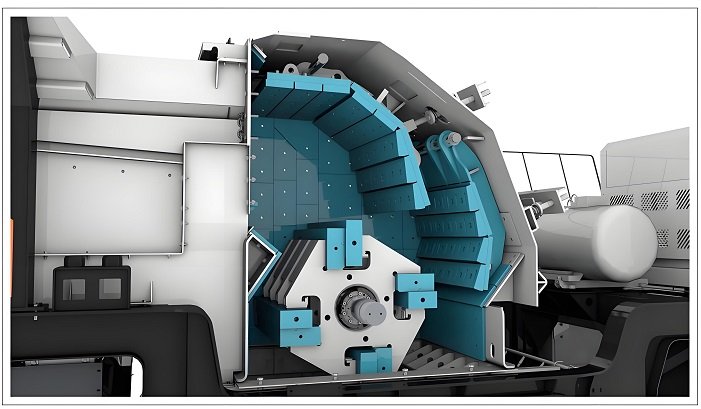
This crushing process repeats within the chambers formed by the first and second impact racks. Throughout this process, the material is subjected not only to hammer blows and impacts from the racks but also to collisions and grinding between the particles themselves, which promotes the propagation of internal fractures until the material is pulverized.
Once the particle size falls below the discharge gap between the impact racks and the hammers, the material is discharged from the base of the machine under the force of gravity.
Features of Heavy‑duty Rotor Impact Crusher
- The super-large feed inlet design can accept aniseed, simplify the crushing process, and effectively reduce the investment in production line equipment.
- The heavy-duty dynamically balanced rotor has strong impact power and can stably undertake large-capacity continuous crushing operations for a long time.
- By optimizing the involute crushing cavity, the materials are repeatedly impacted and shaped, resulting in rounded finished product grains and higher-grade aggregates.
- The high-chromium wear-resistant hammer and lining plate have low impact resistance and can be used interchangeably to extend the life of the accessories.
- Fully hydraulic opening and closing and gap adjustment structure, fast and convenient maintenance and replacement, greatly reducing equipment downtime.
- It has built-in overload protection, resistance to blockage and foreign matter, stable and reliable operation, and is suitable for various sand and gravel production lines.
Heavy‑duty Rotor Impact Crusher Applications
Materials suitable for the heavy-duty rotor impact crusher include river pebbles, granite, basalt, iron ore, limestone, quartz, diabase, marble, copper ore, etc.
Applications include sand and gravel yards, mining operations, coal mining, concrete mixing plants, dry-mixed mortar production, power plant desulfurization, quartz sand processing, etc.
Technical Parameters of Heavy‑duty Rotor Impact Crusher
| Model | Feed inlet size (mm) | Maximum feed size (mm) | Capacity (t/h) | Powder(t/h) |
| CI411 (coarse ) | 820×980 | 600 | 100-200 | 90-200 |
| CI412 (fine) | 430×980 | 300 | 60-130 | 90-200 |
| CI421 (coarse ) | 960×1360 | 800 | 200-400 | 180-250 |
| CI422 (fine) | 450×1360 | 350 | 80-250 | 180-250 |
| CI431 (coarse ) | 1050×1700 | 800 | 300-500 | 200-400 |
| 0432 (fine) | 600xx1700 | 350 | 120-300 | 200-400 |
| CI441 (coarse ) | 1350×1950 | 1000 | 400-700 | 220-440 |
| CI442 (fine) | 650×1950 | 350 | 150-400 | 220-440 |
| CI531 (fine) | 500×2040 | 1000 | 500-800 | 315-355 |
相关产品
-
CI Series Impact Crusher
The CI impact crusher features a high-precision rotor with large rotational inertia, a multi-functional fully hydraulic operating system, and an involute crushing chamber. It offers excellent overall performance and is an ideal choice for coarse and medium crushing in large-capacity crushing production lines.
- Capacity: 60-800 t/h
- Feed Size: <300-1000 mm
- Output Size: 10-80 mm
-
Impact Rock Crusher
Rock impact crushers are primarily used in industries such as mining, construction, chemicals, electric power, and metallurgy. They are suitable for crushing ores with a compressive strength of up to 350 MPa, as well as limestone, slag, coke, and coal. This machine is not suitable for crushing ores with a surface moisture content exceeding 8–10% or for processing sticky materials.
- Capacity: 90-800 t/h
- Feed Size: <900 mm
- Output Size: 10-80 mm
-
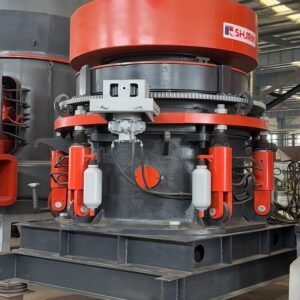
Multi Cylinder Hydraulic Cone Crusher
Multi-cylinder hydraulic cone crushers are typically used as tertiary crushers in stone crushing and sand-making production lines. They can process materials such as quartz, limestone, river pebbles, bluestone, and granite. They are widely used in mining, construction, chemical, transportation, and many other industries.
- Capacity: 100-1200 t/h
- Feed Size: 80-350 mm
- Output Size: 13-38 mm
-
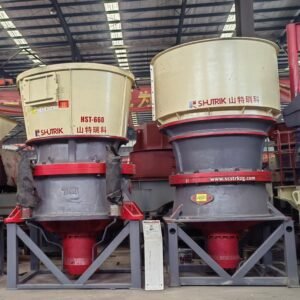
Cone Rock Crusher
The rock cone crusher is a high-performance crushing machine. It is primarily used for secondary and tertiary crushing in metal mining and construction aggregate processing. With its strong crushing capability and high output, it crushes medium-hard materials.
- Capacity: 10-2128 t/h
- Feed Size: 50-560 mm
- Output Size: 6-41 mm
-
PEV Jaw Crusher
The PEV series jaw crusher is suitable for the primary and secondary crushing of various hard ores—such as granite, river pebbles, basalt, and iron ore—with a compressive strength not exceeding 300 MPa. It is widely used in mining, quarrying, construction, and metallurgy.
- Capacity: 55 -1590 t/h
- Feed Size: ≤ 750 – 2000 mm
- Output Size: 40-300 mm
-
PE Jaw Crusher
PE jaw crusher is one of the earliest types of stone crushing equipment. It features a simple, robust structure and reliable operation, is easy to maintain and service, and entails relatively low production and construction costs. It is used for the primary crushing of various ores and rocks with a compressive strength not exceeding 320 MPa.
- Capacity: 5 -1000 t/h
- Feed Size: ≤ 200 – 1200 mm
- Output Size: 20-350 mm