
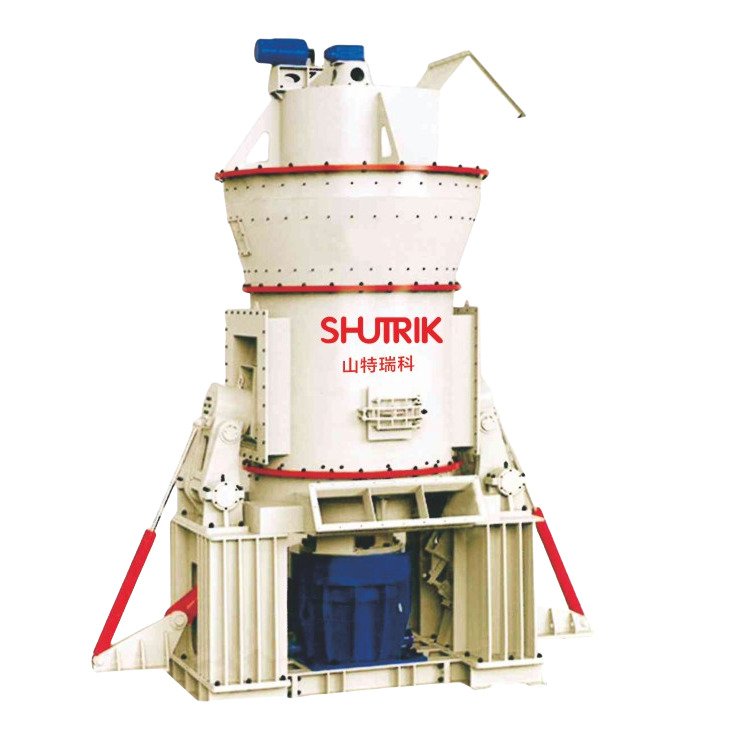
The vertical roller mill for sale is a machine used for grinding raw cement meal, cement clinker, slag, and coal cinder. It features a simple structure and low manufacturing and operating costs.
Sandreck’s vertical roller mill utilizes a vertical roller mill design, with grinding rollers positioned above the grinding table. Pressure is applied to the rollers via a hydraulic system, ensuring they do not make direct contact with the table. This results in low noise and minimal wear, effectively reducing metal contamination. Equipped with a powerful built-in drying system, it can directly process sticky, moist materials with a moisture content of up to 15%.
Our vertical grinding mill is widely used for large-scale powder processing in sectors such as mining, cement, building materials, power generation, and metallurgy.

Vertical Roller Mill Working Principle
The vertical roller mill machine primarily consists of the grinding roller assembly, grinding table assembly, hydraulic station, rocker arm assembly, powder separator, main gearbox, electric motor, mill housing, lubrication station, and PLC control cabinet.
During operation, the main motor drives the grinding table to rotate via the gearbox. Simultaneously, hot air enters the mill housing through the air inlet. Material is fed onto the center of the grinding table. Driven by centrifugal force, the material moves evenly from the center toward the edge of the table. As it passes through the grinding track, it is crushed and ground by the rollers. Large chunks are crushed directly, while finer particles are compressed to form a material bed, undergoing inter-particle grinding.
The ground material continues moving toward the edge of the table until it is entrained by the strong airflow at the air ring. Larger particles fall back onto the table for further grinding. As the material-laden airflow passes through the upper separator, the rotor blades direct coarse particles back to the table for regrinding, while qualified fine powder exits the mill with the airflow and is collected by the system’s dust collector. This collected powder constitutes the final product of the vertical mill.
Foreign objects, such as iron pieces mixed in with the feed, move to the edge of the table but—due to their high mass—cannot be lifted by the airflow. Instead, they fall into the lower chamber of the mill. A scraper mounted at the bottom of the grinding table then directs this material into the discharge chute to be removed from the grinding mill.

Features of Vertical Roller Mill Machine
- High Integration: The vertical roller mill for sale integrates crushing, drying, grinding, classifying, and conveying functions into a single unit. It features a high degree of automation, a compact footprint, and easy maintenance.
- Wear-Resistant and Durable: The grinding rollers do not make direct contact with the grinding table. Instead, the rotating table supports the material, creating a cushioning material bed. This results in low noise and minimal wear, while effectively reducing metal contamination. The roller sleeves are reversible, extending their service life.
- Efficient Drying: The vertical grinding mill features a powerful built-in drying system. An internal water spray device atomizes water to stabilize the material bed and regulate grinding temperatures. It can directly process sticky, moist materials with a moisture content of up to 15%, eliminating the need for separate drying equipment.
- Energy-Efficient and High-Output: The vertical roller mill machine accepts large feed particles—up to 3%–5% of the roller diameter—enabling large-scale material processing with outputs ranging from 20 to 240 t/h. Operational energy consumption is low, offering a 30%–50% reduction compared to ball mills.
- Precise Control: The fineness of the finished product is fully adjustable within the 80–600 mesh range, with a passing rate of ≥90% at 325 mesh. It delivers stable output and a concentrated, uniform particle size distribution.

Vertical Roller Mill Machine Applications
The raw material vertical roller mill is primarily used in cement production lines to grind raw materials—such as limestone, clay, and iron powder—for the preparation of raw meal. It features high grinding efficiency, low power consumption, and the ability to handle large feed particle sizes.
The cement vertical mill is used for grinding cement clinker. It offers advantages such as energy savings, reduced investment costs, low noise levels, and the ability to quickly and conveniently switch between product varieties.
The slag vertical roller mill machine is used for grinding metallurgical solid wastes, such as granulated blast furnace slag.
The vertical coal grinding mill (medium-speed coal mill) is widely used for pulverized coal preparation in industries such as cement, electric power, iron and steel, metallurgy, and chemicals.
The desulfurization vertical mill is used to prepare limestone powder for flue gas desulfurization processes in thermal power plants.

Technical Parameters of Vertical Roller Mill Machine
Mineral ore vertical roller mill (non-metallic minerals, metallic ores, cement raw meal, etc.)
| Specifications | SRM19-2K | SRM22-2K | SRM24-2K | SRM27-2K | SRM27-3K | SRM31-2K | SRM31-3K | SRM34-2K | SRM34-3K | SRM37-3K | SRM39-3K | SRM44-4K | SRM50-4K |
| Capacity (t/h) | 10~40 | 15~50 | 20~70 | 25~85 | 30-90 | 38~135 | 40~145 | 46~160 | 48~170 | 55~196 | 65~220 | 75~260 | 90~400 |
| Max Input Size (mm) | 30 | 30 | 35 | 35 | 35 | 45 | 45 | 45 | 50 | 50 | 50 | 50 | <55 |
| Main Mill Power (KW) | 200~220 | 280~315 | 400~450 | 500~560 | 500~630 | 630~900 | 710~1000 | 800~1120 | 800~1250 | 900~1600 | 1120~1800 | 1800~2200 | 2500~3150 |
| Best Input Moisture | <4% | <4% | <4% | <4% | <4% | <4% | <4% | <4% | <4% | <4% | <4% | <4% | <4% |
| Input Moisture needs Drying | <15% | <15% | <15% | <15% | <15% | <15% | <15% | <15% | <15% | <15% | <15% | <15% | <15% |
| Output Size | 840-37 | 840-37 | 840-37 | 840-37 | 840-37 | 840-37 | 840-37 | 840-37 | 840-37 | 840-37 | 840-37 | 840-37 | 840-37 |
| μm | 20-400 | 20-400 | 20-400 | 20-400 | 20-400 | 20-400 | 20-400 | 20-400 | 20-400 | 20-400 | 20-400 | 20-400 | 20-400 |
| Power Moisture after Drying | ≤1% | ≤1% | ≤1% | ≤1% | ≤1% | ≤1% | ≤1% | ≤1% | ≤1% | ≤1% | ≤1% | ≤1% | ≤1% |
Note. The above capacity is based on grinding brittle material with Mohs hardness < 6 and a grindability (Bond) index ≤10KWh/t.
Coal vertical grinding mill (industries like metallurgical blast furnace coal injection, new energy, kiln fuel, thermal boiler coal powder, cement and others)
| Specifications | SRM12-2M | SRM17-2M | SRM19-2M | SRM22-2M | SRM24-2M | SRM27-2M | SRM31-2M | SRM31-3M | SRM34-3M | SRM37-3M |
| Capacity (t/h) | 4~6 | 7~10 | 10~17 | 16~22 | 20~30 | 26~40 | 35~50 | 40~65 | 45~80 | 65~100 |
| Max Input Size (mm) | 38 | 38 | 40 | 40 | 45 | 45 | 50 | 50 | 50 | 50 |
| Main Mill Power (kW) | 55~75 | 110~132 | 185~220 | 250~280 | 315~355 | 400~500 | 500~630 | 560~800 | 710~900 | 900~1250 |
| Coal Input Moisture | <15% | <15% | <15% | <15% | <15% | <15% | <15% | <15% | <15% | <15% |
| Coal Output Size (R0.08) | 10-20% | 10-20% | 10-20% | 10-20% | 10-20% | 10-20% | 10-20% | 10-20% | 10-20% | 10-20% |
| Coal Power Moisture | <1-5% | <1-5% | <1-5% | <1-5% | <1-5% | <1-5% | <1-5% | <1-5% | <1-5% | <1-5% |
Note: The above capacity is based on grinding bitumite, with HGI (Hardgrove Grindability Index) ≥55.
Superfine vertical roller mill machine (superfine heavy calcium and other non-metallic minerals, chemical industry, etc)
| Specifications | SRM17-2X | SRM19-2X | SRM22-2X | SRM24-2X | SRM27-2X | SRM34-2X | SRM34-3X |
| Capacity (t/h) | 2-6 | 3-13 | 4-16 | 6-24 | 7-28 | 9-35 | 12-40 |
| Max Input Size (mm) | 10 | 10 | 10 | 15 | 15 | 20 | 20 |
| Max Input Moisture | 4% | 4% | 4% | 4% | 4% | 4% | 4% |
| Output Size (10-40μm) | 90-97% | 90-97% | 90-97% | 90-97% | 90-97% | 90-97% | 90-97% |
Note: The technical data is subject to change without prior notice.
Sand powder vertical roller mill
| Specifications | SRMM1 9-2Y | SRM22-2Y | SRM24-2Y | SRM27-2Y | SRM27-3Y | SRM31-2Y | SRM31-3Y | SRM34-2Y | SRM34-3Y | SRM37-3Y | SRM39-3Y | SRM44-4Y | SRM50-4Y |
| Throughput(t/h) | 30-80 | 35-120 | 40-150 | 50-200 | 55-220 | 65-250 | 80-300 | 120-450 | 130-500 | 140-550 | 160-600 | 240-700 | 300-900 |
| Max Input Size (mm) | 30 | 30 | 35 | 35 | 35 | 45 | 45 | 45 | 50 | 50 | 50 | 50 | 55 |
| Best Input Moisture | ≤3% | ≤3% | ≤3% | ≤3% | ≤3% | ≤3% | ≤3% | ≤3% | ≤3% | ≤3% | ≤3% | ≤3% | ≤3% |
| Output Size (≤0.08mm) | ≥25% | ≥25% | ≥25% | ≥25% | ≥25% | ≥25% | ≥25% | ≥25% | ≥25% | ≥25% | ≥25% | ≥25% | ≥25% |
| Output Size (≤2mm) | ≥80% | ≥80% | ≥80% | ≥80% | ≥80% | ≥80% | ≥80% | ≥80% | ≥80% | ≥80% | ≥80% | ≥80% | ≥80% |
Note. The above capacity is based on grinding material with a grindability (Bond) index ≤18KWh/t.


Related products
-
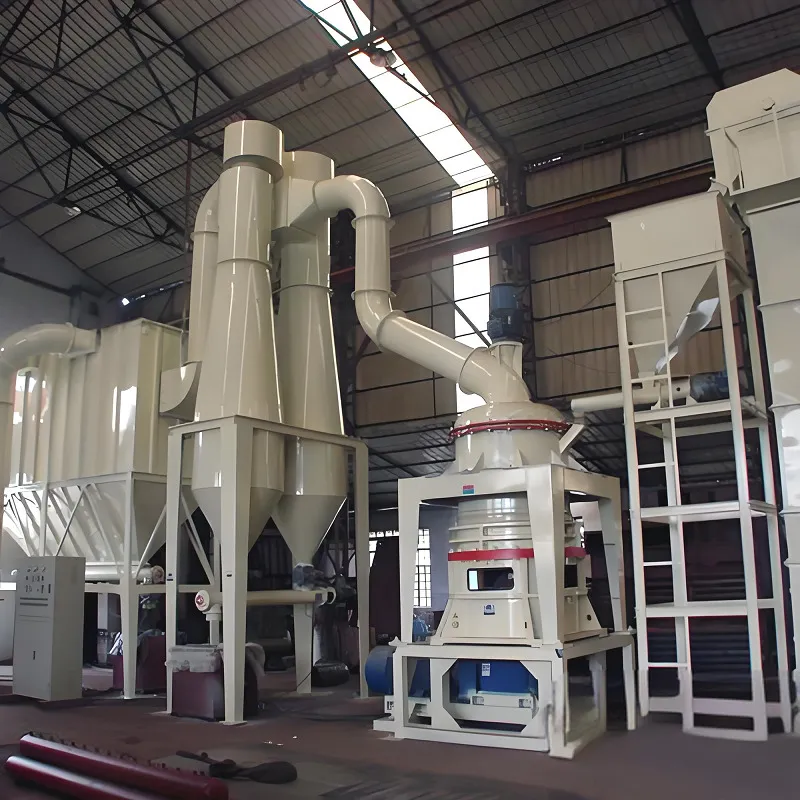
Micro Powder Grinding Mill
The micro powder grinding mill is an advanced piece of equipment designed for the dry, superfine grinding of non-metallic powders. It is widely used in applications such as calcium carbonate pulverization, gypsum powder processing, power plant desulfurization, non-metallic mineral powder production, and pulverized coal preparation. The finished products find extensive application across various sectors, including construction, building materials, glass, ceramics, and the chemical industry.
- Capacity: 0.5 – 25 t/h
- Feed Size: ≤ 20 mm
- Output Size: 325 – 3250 mesh
-
Ultrafine Grinding Mill
Ultrafine grinding mills are pulverizing machines designed to produce ultrafine powders. They are primarily used in industries such as non-metallic minerals, chemicals, construction materials, and coatings. These grinding mills can process minerals—including limestone, calcite, marble, heavy calcium carbonate, pyrophyllite, and talc—into ultrafine powder.
- Capacity: 3 – 25 t/h
- Feed Size: ≤ 15 mm
- Output Size: 300 – 3000 mesh
-
Industrial Ball Mill
The industrial ball mill is a grinding device widely used in industries such as mining, building materials, and chemicals, primarily employed for the crushing, grinding, and mixing of materials, as well as the production of ultrafine powders.
- Capacity: 0.65-130 t/h
- Feed Size: ≤ 25 mm
- Output Size: 0.074-0.89 mm
-
Ball Grinding Mill
A ball mill grinder is a grinding machine that uses steel balls as the grinding medium. It can crush and grind materials to a fineness of 35 mesh or finer and is suitable for use in open-circuit or closed-circuit grinding processes.
- Capacity: 0.65-130 t/h
- Feed Size: ≤ 25 mm
- Output Size: 0.074-0.89 mm
-
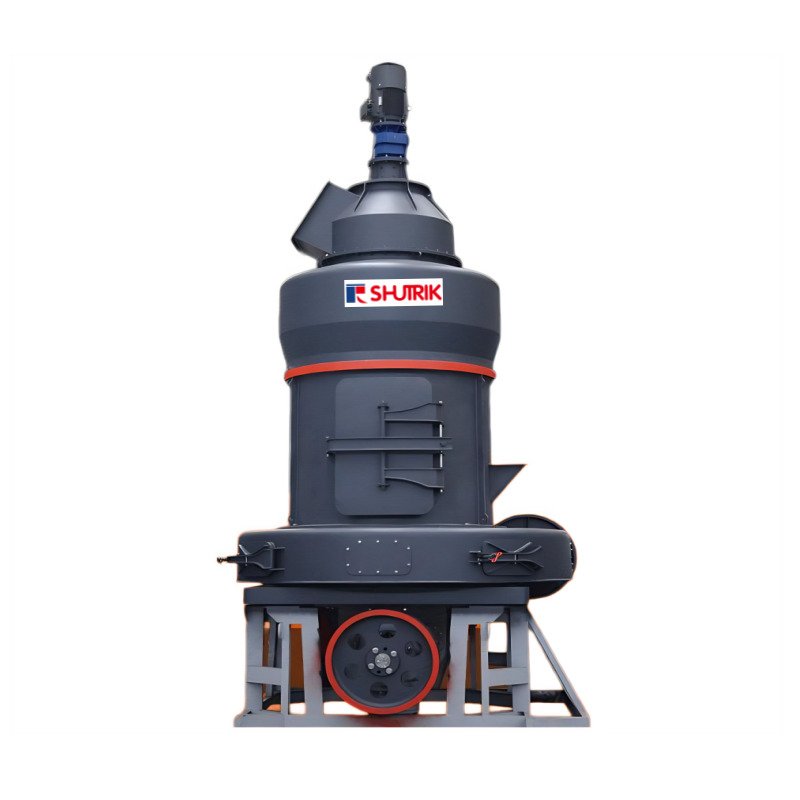
Raymond Grinding Mill
The Raymond grinding mill is a type of dry-grinding suspended-roller mill. It is widely used in the non-metallic mining industry and is capable of grinding rock into fine powder.
- Capacity: 0.25-22 t/h
- Feed Size: ≤35 mm
- Output Size: 0.005-0.613 mm
-
Raymond Roller Mill
The Raymond roller mill is a high-efficiency grinding machine featuring a vertical structure. It is primarily used for processing non-metallic minerals into fine and ultrafine powders and is widely applied in industries such as mining, construction materials, chemicals, and metallurgy.
- Capacity: 0.25-22 t/h
- Feed Size: ≤35 mm
- Output Size: 0.005-0.613 mm
