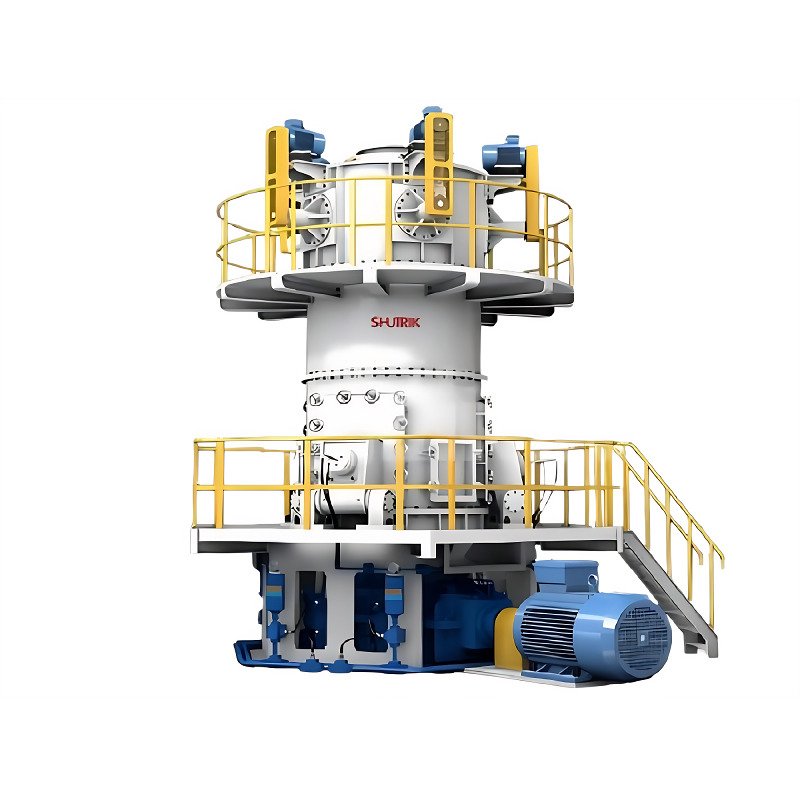

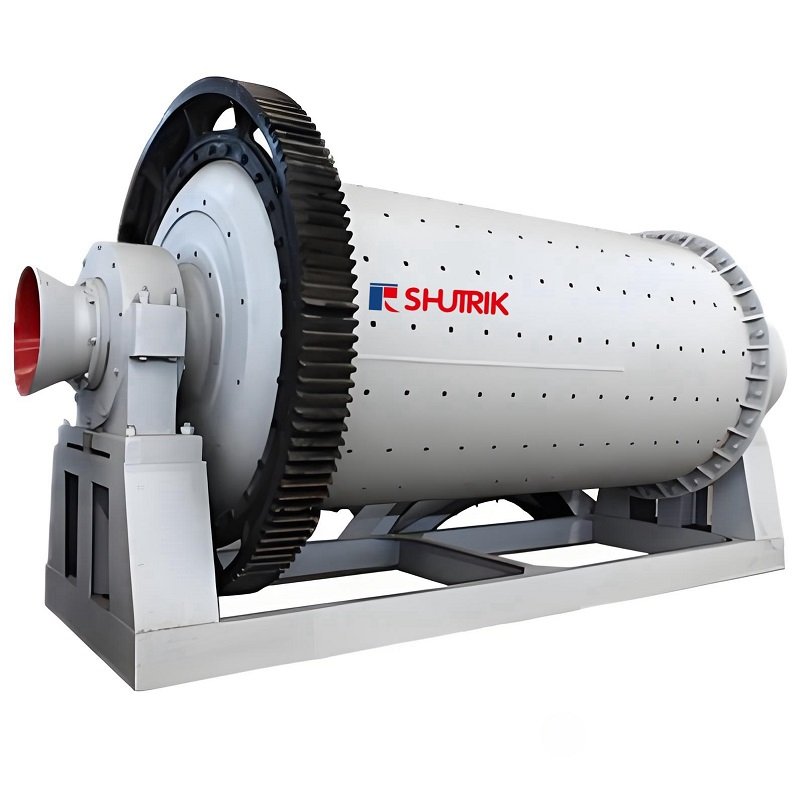
Ball mill machines pulverize materials primarily through the impact and grinding action of steel balls (or ceramic balls) against the material within a rotating cylinder. It employs a physical comminution method based on a “rotating cylinder plus grinding media” configuration. Sandreck‘s industrial ball mills are characterized by their high adaptability and controllable output fineness, serving as core grinding equipment in mineral processing and building material production.
The ball mill equipment is a critical piece of equipment for the fine grinding of materials that have already undergone preliminary crushing. It is widely used across various industries, including cement, silicate products, new building materials, refractories, fertilizers, ferrous and non-ferrous metal beneficiation, and glass and ceramics. Industrial ball mills are capable of performing both dry and wet grinding on a wide range of ores and other grindable materials.

Industrial Ball Mill Working Principle
Raw material is fed through a hollow trunnion into a hollow cylinder for grinding. The cylinder contains grinding media of various diameters (such as steel balls, steel rods, or pebbles). As the cylinder rotates around its horizontal axis at a specific speed, the media and raw material inside are lifted to a certain height along with the cylinder wall, driven by centrifugal force and friction.
When the force of gravity exceeds the centrifugal force, the media and material break away from the inner wall, falling or rolling down and crushing the ore through impact. Simultaneously, the sliding motion between the grinding media during rotation exerts an abrasive action on the material. The ground material is discharged through the hollow trunnion.

Features of Industrial Ball Mill
1. High-Efficiency Grinding: By optimizing the shape, size, and ratio of grinding media, as well as adjusting the drum’s rotational speed and filling rate, industrial ball mills achieve efficient and uniform grinding, thereby enhancing product quality and production efficiency.
2. Strong Adaptability: Ball mill machines can process materials of varying hardness and particle sizes. Furthermore, by adjusting process parameters, they can flexibly meet the production requirements of different products.
3. Ease of Operation: Modern ball mill equipment often utilizes automated control systems for remote monitoring and intelligent adjustment, reducing operational complexity and labor costs.
4. Energy Efficiency and Environmental Friendliness: Technological advancements have led to significant improvements in energy conservation and environmental protection—such as the use of variable-frequency speed control to lower energy consumption and sealed structures to minimize dust emissions.

Industrial Ball Mill Applications
Ball mill machines rely on the impact and grinding action of steel balls and are widely used in industries such as mining, construction materials, chemicals, and metallurgy. They operate in two main modes: dry grinding and wet grinding.
1) Mining and Mineral Processing Industry
Non-ferrous and ferrous metal ores (e.g., iron, copper, lead-zinc, gold, tungsten): Crushed ore undergoes grinding to reduce particle size and liberate valuable minerals from gangue, preparing the material for subsequent flotation, gravity separation, or magnetic separation.
Non-metallic mineral processing: Fine grinding of materials such as fluorite, barite, kaolin, and graphite.
Wet ball mills are predominantly used in mineral processing.
2) Construction Materials Industry
Cement production: Grinding of clinker, limestone, and gypsum. Industrial ball mills serve as core equipment in cement production lines.
Ceramics industry: Wet grinding of ceramic raw materials, china clay, and glazes.
Preparation of sand and gravel, limestone powder, and lime powder.
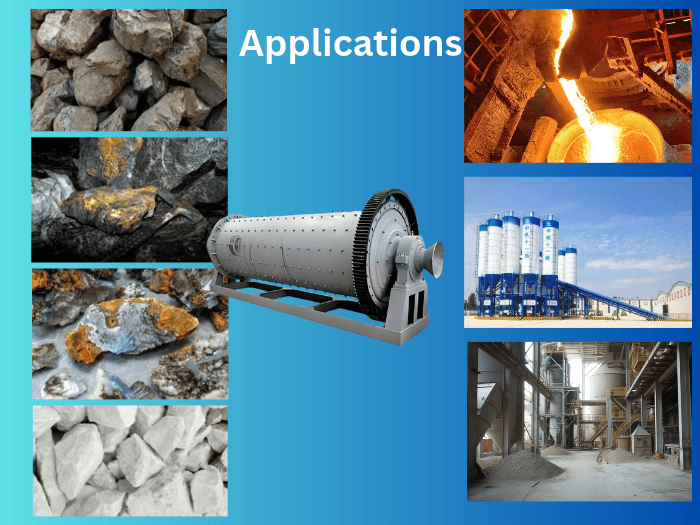
3) Chemical Industry
Pulverizing and mixing of fertilizer raw materials, pigments, fillers, and various chemical powders.
Grinding of raw materials for refractory products to produce refractory powders.
4) Metallurgy Industry
Pre-treatment of smelting raw materials and preparation of sintering feed powders.
Fine grinding of metallurgical ores such as manganese and chromium ores.
5) Other Fields
Pulverized coal preparation: Dry ball mills used to grind coal for boilers.
Quartz sand and silicon powder processing: Dry grinding of quartz powder for photovoltaic applications.
Laboratory-scale ball mills: Grinding of small sample batches and scientific research experiments.
Technical Parameters of Industrial Ball Mill
| Model | Rotary Speed(r/min) | Ball Load(t) | Input Size (mm) | Output Size (mm) | Capacity(t/h) | Power (kW) | Weight (t) |
| Φ900 × 1 800 | 36-38 | 1.5 | ≤20 | 0.075-0.89 | 0.65-2 | 18.5 | 4.6 |
| Ф900 × 3000 | 36 | 2.7 | ≤20 | 0.075-0.89 | 1.1-3.5 | 22 | 5.6 |
| Φ1200 × 2400 | 36 | 3 | <25 | 0.075-0.6 | 1.5-4.8 | 30 | 12 |
| Φ1200 × 3000 | 36 | 3.5 | <25 | 0.074-0.4 | 1.6-5 | 37 | 12.8 |
| Φ1200 × 4500 | 32.4 | 5 | ≤25 | 0.074-0.4 | 1.6-5.8 | 55 | 13.8 |
| Φ1500 × 3000 | 29.7 | 7.5 | <25 | 0.074-0.4 | 2-5 | 75 | 15.6 |
| Φ1500 × 4500 | 27 | 11 | <25 | 0.074-0.4 | 3-6 | 90 | 21 |
| Φ1500 × 5700 | 28 | 12 | <25 | 0.074-0.4 | 3.5-6 | 130 | 24.7 |
| Φ1830 × 3000 | 25.4 | 11 | <25 | 0.074-0.4 | 4-10 | 130 | 28 |
| Ф1830 × 4500 | 25.4 | 15 | <25 | 0.074-0.4 | 4.5-12 | 155 | 32 |
| Φ1830 × 6400 | 24.1 | 21 | <25 | 0.074-0.4 | 6.5-15 | 180 | 34 |
| Φ1830 × 7000 | 24.1 | 23 | <25 | 0.074-0.4 | 7.5-17 | 210 | 36 |
| Φ2100× 3000 | 23.7 | 15 | <25 | 0.074-0.4 | 6.5-36 | 210 | 34 |
| Φ2100 × 4500 | 23.7 | 24 | ≤25 | 0.074-0.4 | 8-43 | 245 | 42 |
| Φ2100 × 7000 | 23.7 | 26 | <25 | 0.074-0.4 | 8-48 | 280 | 50 |
| Φ2200 × 4500 | 21.5 | 27 | ≤25 | 0.074-0.4 | 9-45 | 280 | 48.5 |
| Φ2200 × 6500 | 21.7 | 35 | <25 | 0.074-0.4 | 14-26 | 370 | 52.8 |
| Φ2200 × 7000 | 21.7 | 35 | ≤25 | 0.074-0.4 | 15-28 | 380 | 54 |
| Φ2200 × 7500 | 21.7 | 35 | <25 | 0.074-0.4 | 15-30 | 380 | 56 |
| Φ2400 × 4500 | 21 | 30 | <25 | 0.074-0.4 | 8.5-60 | 320 | 65 |
| Φ2700 × 4000 | 20.7 | 40 | <25 | 0.074-0.4 | 12-80 | 400 | 94 |
| Φ2700 × 4500 | 20.7 | 48 | ≤25 | 0.074-0.4 | 12-90 | 430 | 102 |
| Φ3200 × 4500 | 18 | 65 | <25 | 0.074-0.4 | 25-130 | 800 | 137 |



Related products
-
Micro Powder Grinding Mill
The micro powder grinding mill is an advanced piece of equipment designed for the dry, superfine grinding of non-metallic powders. It is widely used in applications such as calcium carbonate pulverization, gypsum powder processing, power plant desulfurization, non-metallic mineral powder production, and pulverized coal preparation. The finished products find extensive application across various sectors, including construction, building materials, glass, ceramics, and the chemical industry.
- Capacity: 0.5 – 25 t/h
- Feed Size: ≤ 20 mm
- Output Size: 325 – 3250 mesh
-
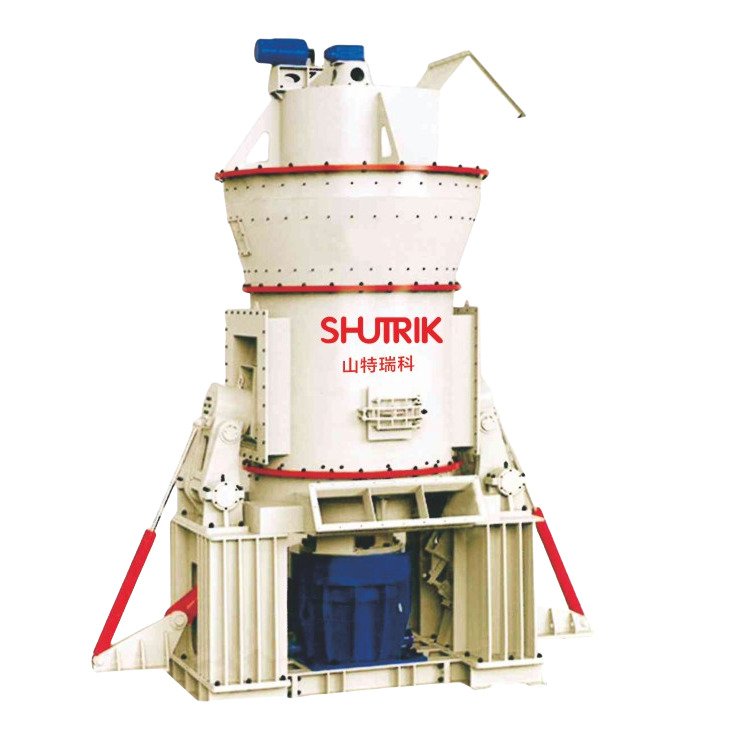
Vertical Grinding Mill
The vertical grinding mill integrates the functions of fine crushing, grinding, drying, classifying, and conveying. The system is simple, easy to operate and adjust, and features a high degree of automation. It is suitable for both large-scale and ultra-large-scale industrial production, as well as for small- and medium-scale operations.
- Capacity: 10 – 400 t/h
- Feed Size: ≤ 55 mm
- Output Size: 20 – 400 mesh
-
Ball Grinding Mill
A ball mill grinder is a grinding machine that uses steel balls as the grinding medium. It can crush and grind materials to a fineness of 35 mesh or finer and is suitable for use in open-circuit or closed-circuit grinding processes.
- Capacity: 0.65-130 t/h
- Feed Size: ≤ 25 mm
- Output Size: 0.074-0.89 mm
-
Grinding Rod Mill
Grinding rod mills are primarily utilized in the first stage of open-circuit grinding for coarse- to fine-size reduction. They are particularly well-suited for brittle ore materials. Our rod mills offer the advantages of uniform product particle size and high throughput.
- Capacity: 100-500 t/h
- Feed Size: <25 mm
- Output Size: 0.074-5 mm
-
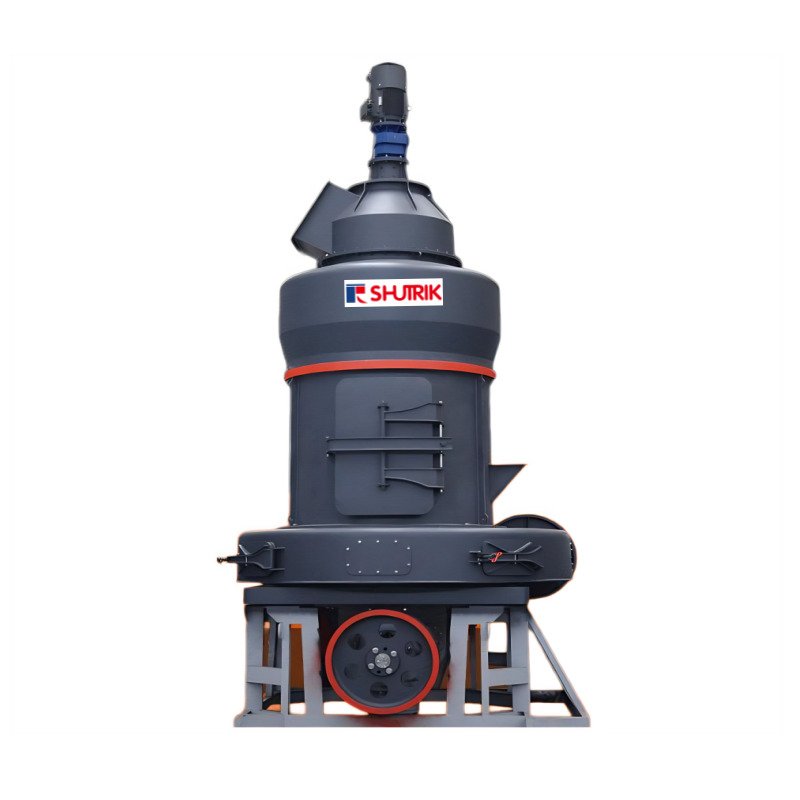
Raymond Grinding Mill
The Raymond grinding mill is a type of dry-grinding suspended-roller mill. It is widely used in the non-metallic mining industry and is capable of grinding rock into fine powder.
- Capacity: 0.25-22 t/h
- Feed Size: ≤35 mm
- Output Size: 0.005-0.613 mm
-
Raymond Roller Mill
The Raymond roller mill is a high-efficiency grinding machine featuring a vertical structure. It is primarily used for processing non-metallic minerals into fine and ultrafine powders and is widely applied in industries such as mining, construction materials, chemicals, and metallurgy.
- Capacity: 0.25-22 t/h
- Feed Size: ≤35 mm
- Output Size: 0.005-0.613 mm