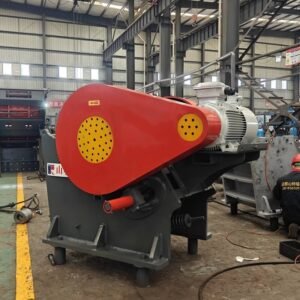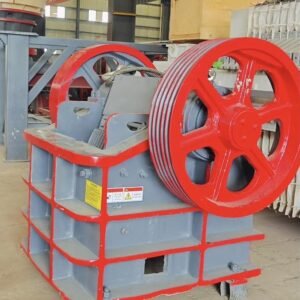
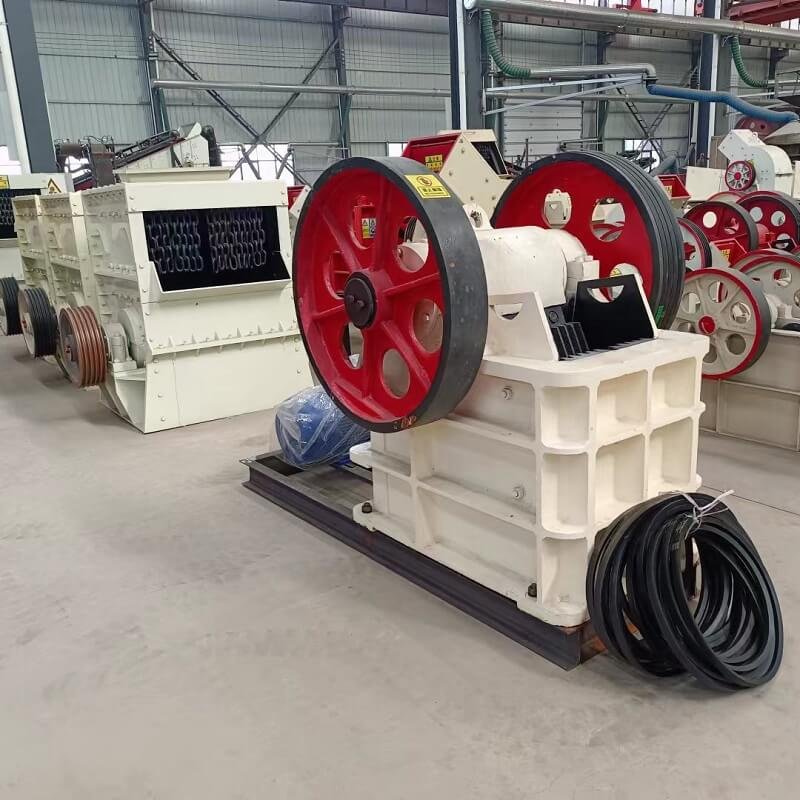
PEX jaw crusher is a large-scale compound-pendulum crushing machine primarily designed for crushing medium-hard ores and rocks with a compressive strength not exceeding 250 MPa. It offers a high reduction ratio, high throughput, uniform product size, reliable operation, easy maintenance, and low operating costs. The PEX series jaw crusher is mainly utilized for secondary and fine crushing operations.
The equipment features a deep-cavity design with no crushing dead zones. With a shim-type discharge opening adjustment mechanism, it offers higher feed capacity and flexible control over output particle size. Sandreck’s PEX jaw crushers utilize cast steel frames and swing jaws, ensuring high strength and a long service life. They also deliver uniform product sizing and high crushing efficiency. These stone crushers are widely used in sectors such as mining, metallurgy, construction materials, highways, railways, water conservancy, and the chemical industry.
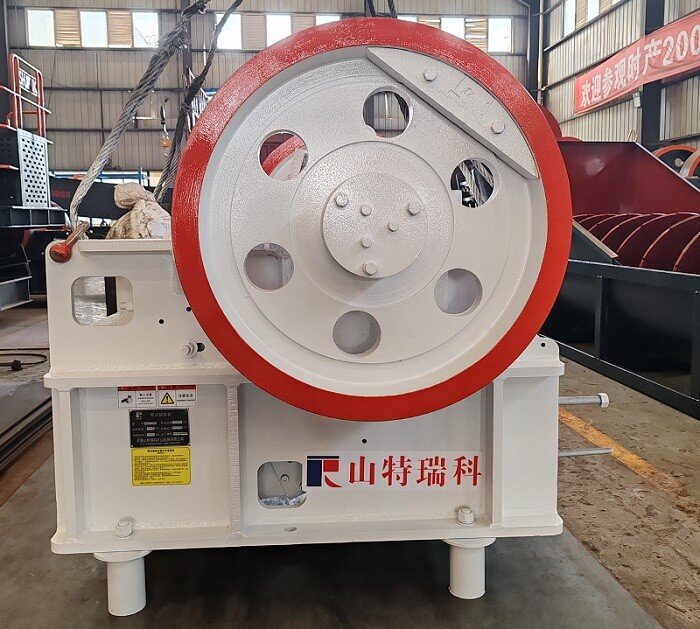
PEX Jaw Crusher Working Principle
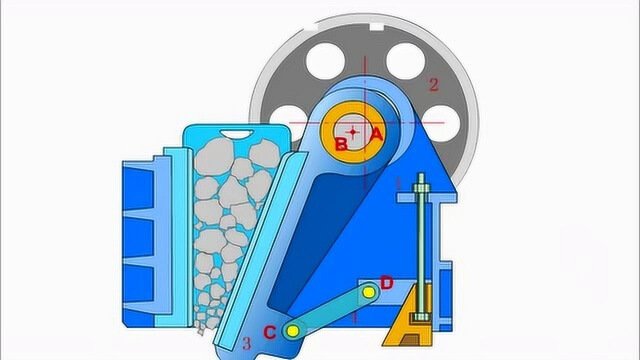
PEX series jaw crusher features a compound pendulum mechanism. The movable jaw performs a combined motion—moving both vertically and horizontally (back and forth). In addition to compression, the process includes grinding and rubbing actions, producing a finer product. It is therefore suitable for secondary fine crushing.
An electric motor drives a pulley, which rotates the eccentric shaft. The eccentric shaft causes the movable jaw to oscillate.
Compression and Crushing: As the eccentric shaft rotates downward, the movable jaw plate moves toward the fixed jaw plate. Ore trapped between the two plates is compressed, ground, and bent, causing it to fracture.
Discharge: As the eccentric shaft continues to rotate, the movable jaw plate retracts away from the fixed jaw plate, widening the gap at the bottom of the crushing chamber. Material smaller than the discharge opening size falls out through the bottom outlet under gravity.
This cycle repeats continuously to achieve uninterrupted crushing.
Advantages of PEX Series Jaw Crusher
- The E-type frame design withstands greater impact forces.
- The deep crushing chamber features no dead zones, enhancing feed capacity and output.
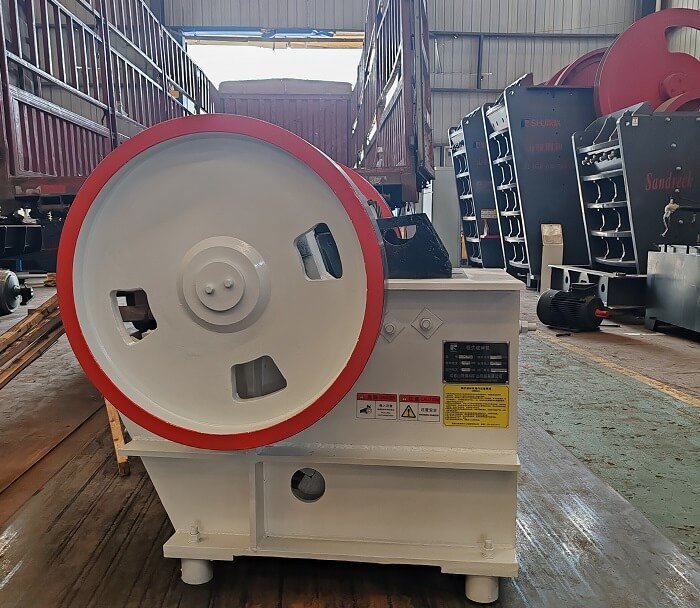
- The large-diameter flywheel structure ensures robustness and durability.
- The movable jaw employs a compound pendulum motion. In addition to compression, it exerts a grinding and rubbing action. This results in a high crushing ratio and fine output, making it ideal for secondary (medium-to-fine) crushing. The finished product is uniform in size with minimal flaky or elongated particles.
- Discharge clearance is adjusted by adding or removing shims, allowing flexible particle-size control to meet diverse production requirements.
- The jaw plates are cast from high-strength manganese steel in a single piece, offering excellent wear resistance, high compressive strength, and a long service life.
PEX Jaw Crusher Application
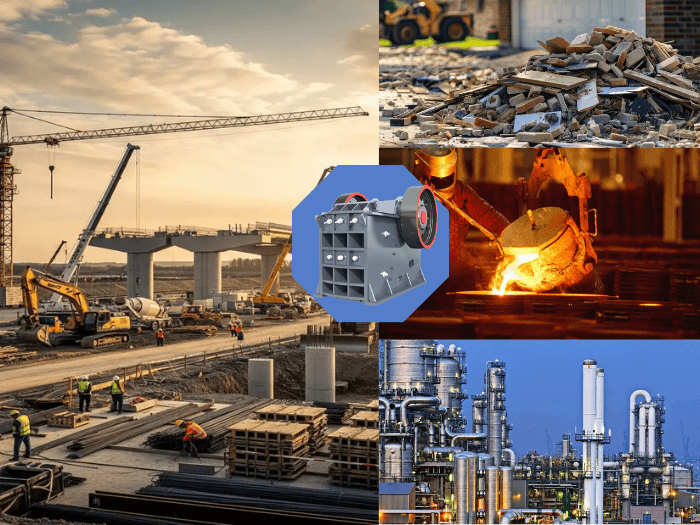
The PEX jaw crusher is designed for secondary (medium and fine) crushing. It typically follows a PE primary jaw crusher and crushes ores and rocks with a compressive strength of ≤250 MPa.
1) Mining and Mineral Processing
- Metal Ores: Secondary fine crushing of materials (such as iron, copper, gold, and manganese ores) after primary crushing. It feeds ball mills to achieve “more crushing, less grinding,” thereby improving grinding efficiency. It serves as a preparatory step for flotation and magnetic separation processes.
- Non-metallic Minerals: Fine crushing of raw materials such as limestone, dolomite, feldspar, fluorite, and phosphate rock.
2) Sand and Aggregate Production Lines
Secondary crushing in sand and stone processing. Used in a configuration comprising a PE primary crusher, a PEX fine crusher, and a vibrating screen to produce 5–20mm concrete aggregates and roadbed stone. It can be paired with a sand-making machine to produce manufactured sand. Widely used in stone quarries for highway, railway, and water conservancy projects.
3) Construction Materials and Cement Industry
Raw material pre-treatment in cement plants (crushing limestone and shale); crushing coal gangue in brick and tile factories; pulverizing raw materials like feldspar in the ceramics industry.
4) Solid Waste Recycling
Crushing construction waste (concrete blocks and waste bricks) to recover recycled aggregates; crushing and reusing coal gangue and slag.
5) Chemical Industry
Medium- and fine-crushing of chemical raw materials such as phosphate rock and pyrite.
Technical Parameters of PEX Series Jaw Crusher
| Model | Feeding Size (mm) | Max. Feeding
Size (mm) |
Adjusting Range of
Discharge Opening (mm) |
Capacity(t/h) | Motor Power(kw) | Overall Dimension
(LxWxH)(mm) |
| PEX-150×250 | 150×250 | 125 | 10-40 | 1-3 | 5.5 | 896×745*935 |
| PEX-150×750 | 150×750 | 125 | 18-48 | 5-16 | 15 | 1200x1500x1200 |
| PEX-250×750 | 250×750 | 210 | 25-60 | 15-30 | 22-30 | 1667*1545*1020 |
| PEX-250X1000 | 250×1000 | 210 | 40-60 | 15-50 | 30-37 | 1695x1921x1440 |
| PEX-250×1200 | 250×1200 | 210 | 40-80 | 20-60 | 37-45 | 2192x1900x1950 |
相关产品
-
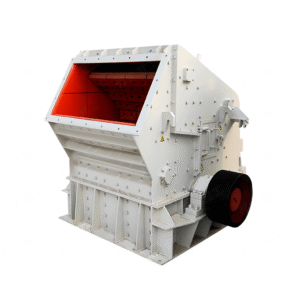
Impact Stone Crusher
Stone impact crushers can be used for secondary and tertiary crushing (medium and fine crushing) operations. They are suitable for various soft to medium-hard materials, such as granite, concrete blocks, basalt, and limestone. They feature a simple structure, reliable performance, and a compact footprint, all at a relatively affordable price.
- Capacity: 90-800 t/h
- Feed Size: <900 mm
- Output Size: 10-80 mm
-
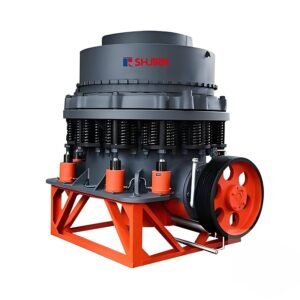
Symons Cone Crusher
The Simmons cone crusher relies on springs for mechanical overload protection. The discharge port requires manual adjustment during machine shutdown. The machine has a simple structure, highly interchangeable parts, and a low operating threshold. It is suitable for small to medium-sized sand and gravel mines.
- Capacity: 12-800 t/h
- Feed Size: 35-300 mm
- Output Size: 3-60 mm
-
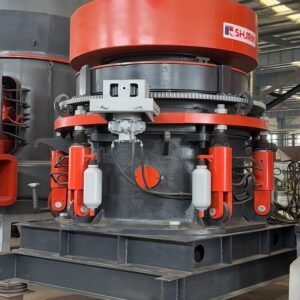
Multi Cylinder Hydraulic Cone Crusher
Multi-cylinder hydraulic cone crushers are typically used as tertiary crushers in stone crushing and sand-making production lines. They can process materials such as quartz, limestone, river pebbles, bluestone, and granite. They are widely used in mining, construction, chemical, transportation, and many other industries.
- Capacity: 100-1200 t/h
- Feed Size: 80-350 mm
- Output Size: 13-38 mm
-
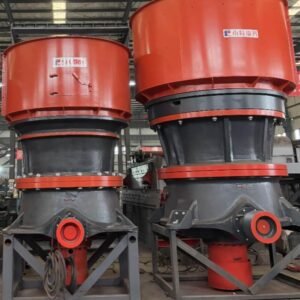
Cone Stone Crusher
The stone cone crusher is equipment used in the mining machinery sector for crushing medium and fine ore. It suits industries such as metallurgy, construction, road building, chemicals, and silicates.
- Capacity: 10-2128 t/h
- Feed Size: 50-560 mm
- Output Size: 6-41 mm
-
PEV Jaw Crusher
The PEV series jaw crusher is suitable for the primary and secondary crushing of various hard ores—such as granite, river pebbles, basalt, and iron ore—with a compressive strength not exceeding 300 MPa. It is widely used in mining, quarrying, construction, and metallurgy.
- Capacity: 55 -1590 t/h
- Feed Size: ≤ 750 – 2000 mm
- Output Size: 40-300 mm
-
PE Jaw Crusher
PE jaw crusher is one of the earliest types of stone crushing equipment. It features a simple, robust structure and reliable operation, is easy to maintain and service, and entails relatively low production and construction costs. It is used for the primary crushing of various ores and rocks with a compressive strength not exceeding 320 MPa.
- Capacity: 5 -1000 t/h
- Feed Size: ≤ 200 – 1200 mm
- Output Size: 20-350 mm