
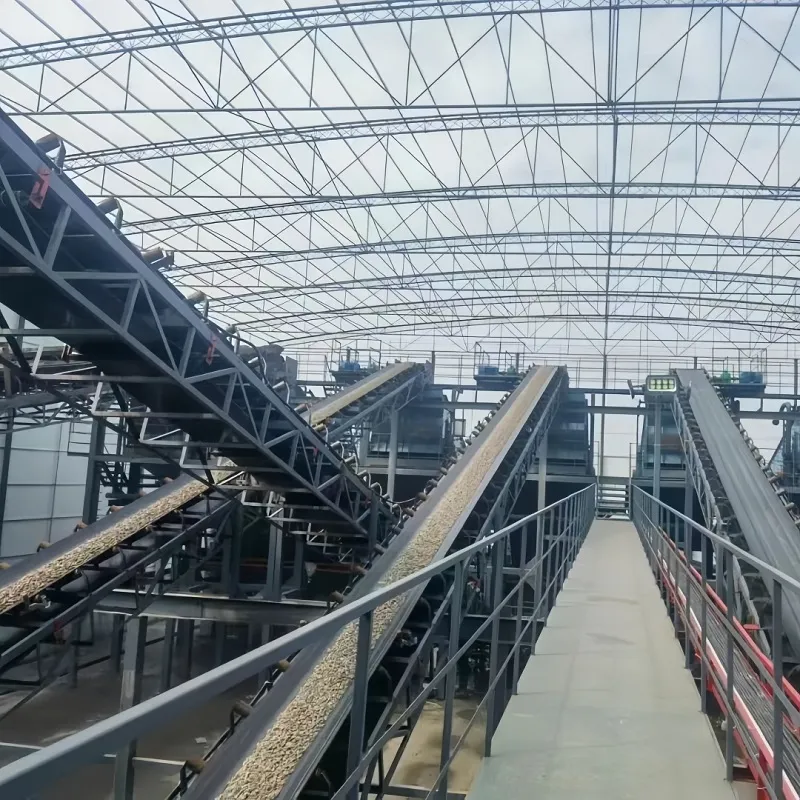
An industrial belt conveyor is mechanical equipment that uses a friction drive to continuously transport materials. It consists primarily of a frame, conveyor belt, idlers, pulleys, a tensioning device, and a drive unit. It transports materials along a specific path from an initial loading point to a final discharge point.
In industrial production, belt conveyors link various pieces of production machinery, creating continuous production workflows. This supports continuous, automated production processes, improving efficiency and reducing labor intensity.
With advantages such as high conveying capacity, simple structure, easy maintenance, low cost, and high versatility, industrial belt conveyors are widely used in sectors including metallurgy, coal mining, transportation, hydropower, and the chemical industry. They also apply to construction materials, electric power, light industry, grain handling, port operations, and shipbuilding.

As a professional belt conveyor supplier, Sandreck offers rubber and PVC conveyor belts, designs belt conveyor systems, and supplies a wide range of replacement belts. These industrial belt conveyors suit facilities such as crushed stone production lines, gravity separation equipment, and gold washing plants.
Industrial Belt Conveyor Working Principle
Industrial belt conveyors transport material continuously by using friction from the drive pulley to drive the conveyor belt in a continuous loop.
Working Principle
- Power Transmission: Power is typically transmitted from a motor, through a speed reducer, to the drive pulley (usually the head pulley). Friction between the drive pulley and the conveyor belt starts the belt moving.
- Belt Circulation: The conveyor belt forms a closed loop, traveling between the drive pulley, bend pulleys, and tensioning pulleys. Idler rollers support the belt to ensure stable operation.
- Material Transport: Material is deposited evenly onto the belt at the loading point. As the belt moves, the material is transported to the discharge end, where it is unloaded via gravity or a scraper.

Throughout this process, friction stability and belt tension control are critical to ensuring continuous operation. A tensioning device is used to maintain appropriate belt tension, preventing slippage or belt mistracking.
Advantages of Industrial Belt Conveyor
- Simple structure, lightweight, and easy to manufacture.
- Flexible layout and broad adaptability, capable of conveying a wide variety of materials.
- High conveying speed, long conveying distance, high capacity, and low energy consumption.
- Enables continuous conveying with smooth operation and no damage to the conveyed materials.
- Simple operation, safety and reliability, easy maintenance and inspection and low maintenance costs.
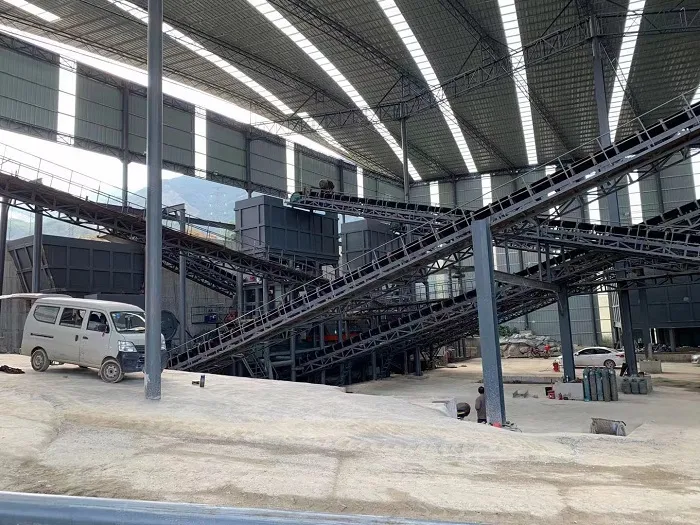
Industrial Belt Conveyor Applications
1. Sand and Aggregate Production Line: Industrial belt conveyors link equipment such as jaw crushers, cone crushers, and vibrating screens to form an automated production line.
2. Concrete Mixing Plant: Heavy-duty belt conveyors transport sand and aggregates to the main mixer, where precise proportioning is carried out via a metering system.
3. Port Terminals: Used for loading and unloading operations, as well as for the long-distance transport of materials to storage yards.
4. Mining Operations: Industrial belt conveyors are used to transport ore, tailings, and other materials, capable of handling steep gradients or complex terrain.
Technical Parameters of Industrial Belt Conveyor
| Model | Belt width (mm) | Angle (°) | Belt speed (m/s) | Maximum feed size (mm) | Capacity (t/h) | (L≤30m) Power (kw) |
| B6X500 | 500 | 0-17° | 1.5 | 100 | 150 | 4-11 |
| B6X650 | 650 | 0-17° | 1.6 | 130 | 250 | 4-11 |
| B6X800 | 800 | 0-17° | 1.4 | 180 | 400 | 5.5-15 |
| B6X1000 | 1000 | 0-17° | 1.4 | 250 | 600 | 7.5-18.5 |
| B6X1200 | 1200 | 0-17° | 1.4/1.5 | 300 | 900 | 11-12 |


Related products
-
Heavy Duty Belt Conveyor
Heavy-duty belt conveyors are widely used in mining, metallurgy, coal, transportation, and hydropower to convey bulk materials or packaged goods. This equipment offers long conveying distances, high capacity, low operating resistance, easy installation, low energy consumption, and minimal wear.
- Capacity: 150 – 900 t/h
- Feed Size: ≤ 300 mm
- Belt Width: 500 – 1200 mm
-
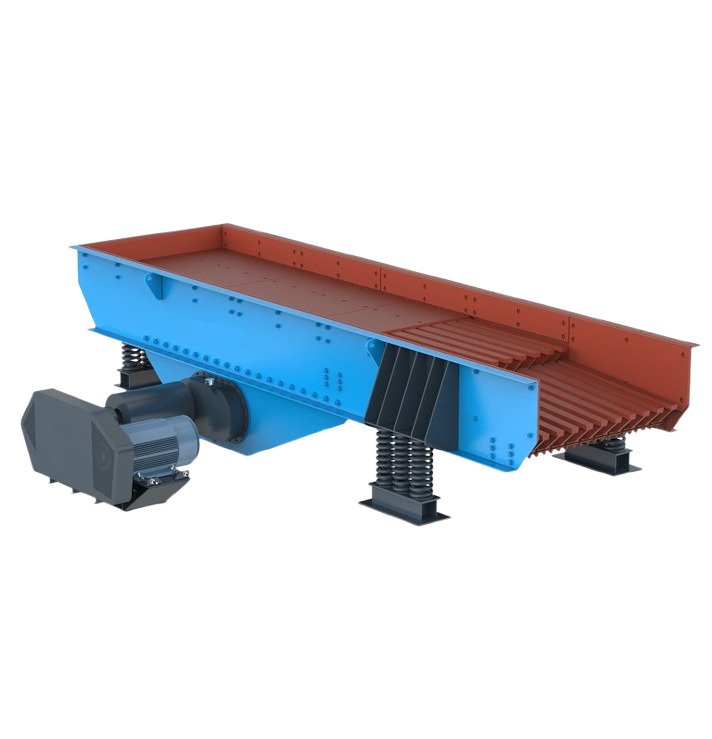
Vibration Feeder
This vibration feeder is widely used in the crushing and screening stages of mining and aggregate production lines to ensure continuous, uniform material feeding.
- Capacity: 400 – 1200 t/h
- Feed Size: ≤ 1500 mm
- Motor Power: 15 – 45 kW
-
Vibrating Feeder Machine
Vibrating feeders for sale are widely used across various industries, including mining, metallurgy, coal, building materials, and machinery. They are used to feed lump, granular, and powdered materials—uniformly, continuously, or at a controlled rate—from storage bins or hoppers into receiving equipment.
- Capacity: 400 – 1200 t/h
- Feed Size: ≤ 1500 mm
- Motor Power: 15 – 45 kW