

The heavy duty belt conveyor is a continuous conveying system widely used in industries such as mining, construction materials, and concrete mixing plants. It is designed to transport bulk materials, including sand, gravel, and aggregates, efficiently and stably. With high conveying capacity, smooth operation, and easy maintenance, it is a critical component in modern sand and aggregate production lines.
Heavy-duty belt conveyor machines suit a wide range of operational sites, working environments, and material types, meeting the demands of various mining and mineral processing applications.
Using the conveyor belt as both the traction and load-bearing element, the equipment enables continuous transport of bulk materials and packaged goods. It delivers materials efficiently and steadily to downstream equipment, ensuring smooth production. The belt conveyor integrates seamlessly with crushing systems, receiving and transferring materials along the production line. It offers high adaptability, featuring customizable conveying lengths and flexible adjustment of horizontal or inclined angles.
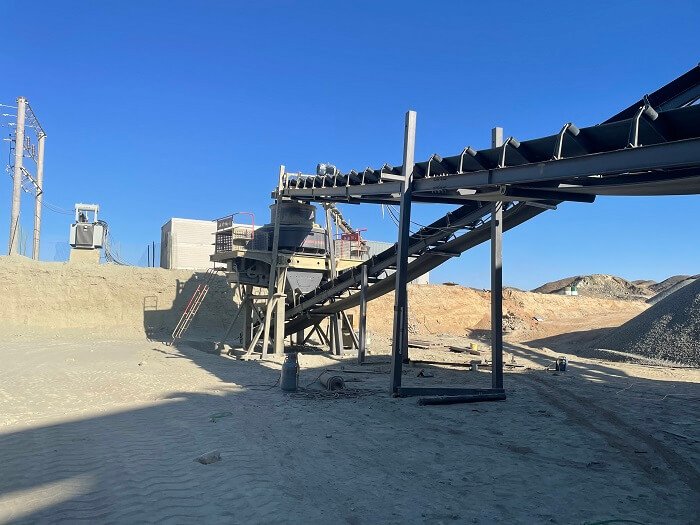
Heavy Duty Belt Conveyor Working Principle
A heavy-duty belt conveyor primarily consists of two end pulleys and a continuous conveyor belt looped tightly around them. The drive pulley (or transmission pulley) drives the belt, while the other, which changes the belt’s direction, is the bend pulley (or return pulley). The drive pulley is powered by an electric motor through a speed reducer, and the belt is propelled by the friction generated between it and the drive pulley. To maximize traction and facilitate movement, the drive pulley is typically positioned at the discharge end. Material is fed onto the moving belt at the loading end and transported to the discharge end by belt friction.

Features of Heavy Duty Belt Conveyor
- Efficient Continuous Conveying: Heavy-duty belt conveyors offer 24/7 continuous operation, making them ideal for large-scale sand and aggregate transport.
- High Adaptability: These belt conveyors handle a wide range of materials—including sand, crushed stone, and manufactured sand—with particle sizes from 0 to 300 mm and moisture content up to 15%.
- Robust Construction: Featuring high-strength belts and wear-resistant idlers, the heavy duty belt conveyors are built to withstand harsh operating environments found in mines and concrete mixing plants.
- Flexible Configuration: The industrial belt conveyors support horizontal, inclined (up to 30°), or combined layouts to meet diverse site and process requirements.
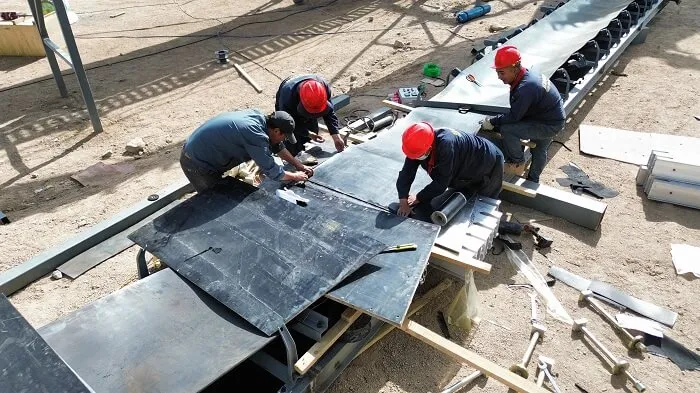
Heavy Duty Belt Conveyor Applications
1) Mining Industry:
Ore Hoisting and Transport: Transporting ore from deep shafts to the surface or from mountain sites, thereby increasing transport efficiency and reducing labor costs.
Waste and Tailings Conveying: Moving waste rock and tailings from processing areas to disposal sites or tailings ponds, supporting efficient resource use and environmental protection.
2) Coal Industry:
Coal Extraction and Processing: Transporting coal from underground workings to the surface, or from processing facilities to coal storage yards.
Adapting to Complex Site Conditions: Enabling efficient, continuous coal transport within challenging site environments.
3) Stone and Aggregate Industry:
Aggregate Conveying: Ensuring continuous and stable material transport to boost production efficiency and lower costs for sand and stone aggregates.
4) Other Industries:
Power, Metallurgy, Chemicals, Grain, etc.: Transporting various bulk materials such as fertilizers, salt, and grain.
Technical Parameters of Heavy Duty Belt Conveyor
| Model | Belt width (mm) | Angle (°) | Belt speed (m/s) | Maximum feed size (mm) | Capacity (t/h) | (L≤30m) Power (kw) |
| B6X500 | 500 | 0-17° | 1.5 | 100 | 150 | 4-11 |
| B6X650 | 650 | 0-17° | 1.6 | 130 | 250 | 4-11 |
| B6X800 | 800 | 0-17° | 1.4 | 180 | 400 | 5.5-15 |
| B6X1000 | 1000 | 0-17° | 1.4 | 250 | 600 | 7.5-18.5 |
| B6X1200 | 1200 | 0-17° | 1.4/1.5 | 300 | 900 | 11-12 |

Related products
-
Industrial Belt Conveyor
Industrial belt conveyors are widely used in mining, quarrying, the chemical industry, construction material recycling, and powder grinding plants. They transport materials such as aggregates, crushed stone, sand, coal, and cement.
- Capacity: 150 – 900 t/h
- Feed Size: ≤ 300 mm
- Belt Width: 500 – 1200 mm
-
Vibration Feeder
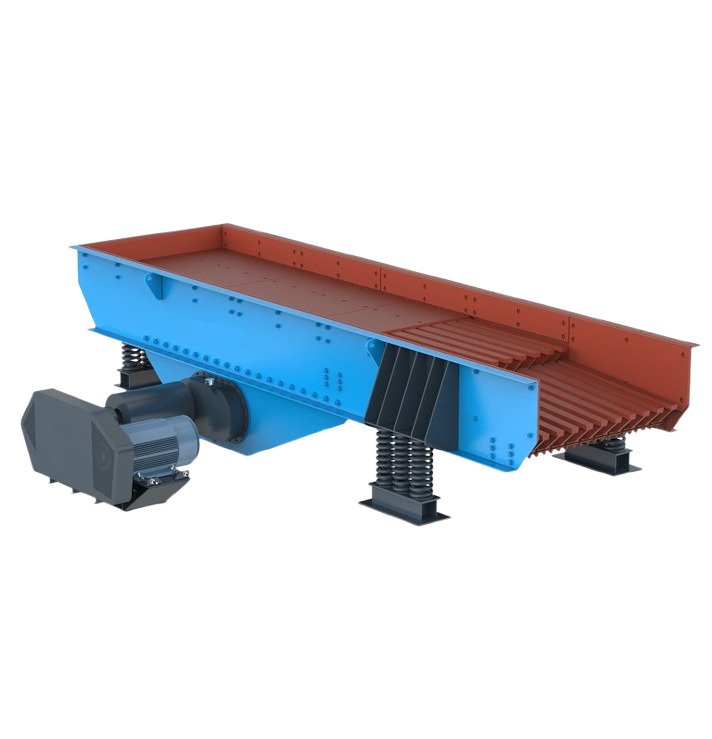
This vibration feeder is widely used in the crushing and screening stages of mining and aggregate production lines to ensure continuous, uniform material feeding.
- Capacity: 400 – 1200 t/h
- Feed Size: ≤ 1500 mm
- Motor Power: 15 – 45 kW
-
Vibrating Feeder Machine
Vibrating feeders for sale are widely used across various industries, including mining, metallurgy, coal, building materials, and machinery. They are used to feed lump, granular, and powdered materials—uniformly, continuously, or at a controlled rate—from storage bins or hoppers into receiving equipment.
- Capacity: 400 – 1200 t/h
- Feed Size: ≤ 1500 mm
- Motor Power: 15 – 45 kW