
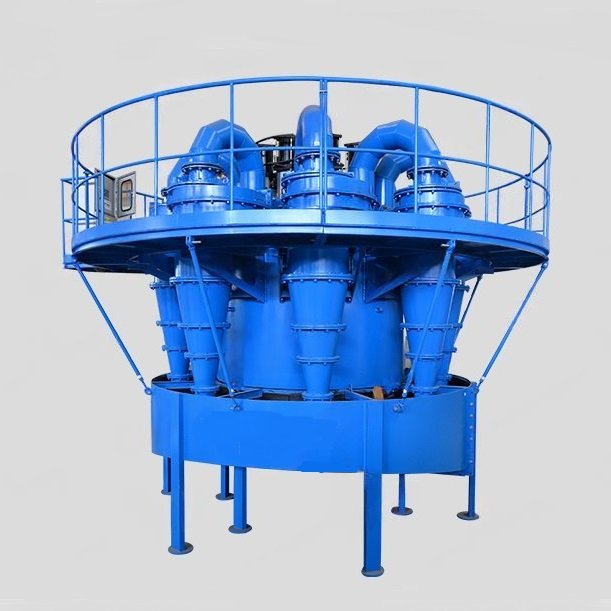
A hydrocyclone, also known as a cyclone separator, is mineral processing equipment used to separate and remove heavier, coarse particles, such as sand and grit, from wastewater or slurries. It is also sometimes used to dewater slurry. Hydrocyclones are classified into two types: pressure-fed and gravity-fed.
The hydrocyclone filter is a classification device. They use centrifugal force to accelerate slurry particle settling and separate particles by size, shape, and specific gravity. Hydrocyclone separators are widely used in the minerals industry, primarily as classifiers in mineral processing. This method has proven highly effective for separating fine particles. They are widely used in closed-circuit grinding and can also deslime, desand, and thicken.
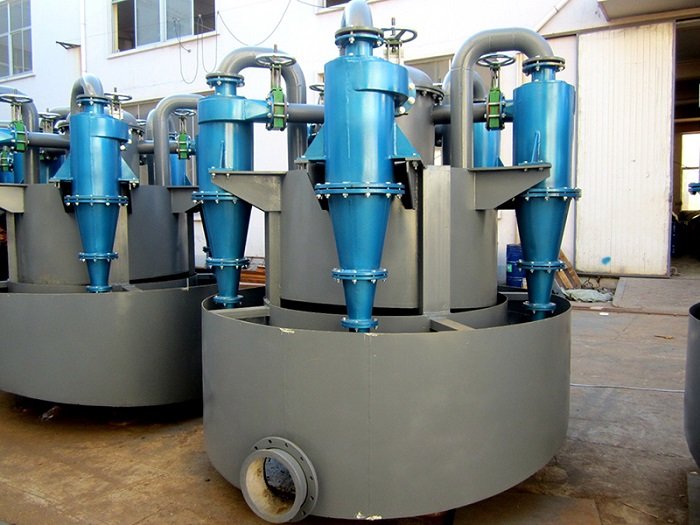
Hydrocyclone Filter Working Principle
When the slurry enters the cylinder tangentially through the feed pipe—driven by a sand pump (or a difference in elevation) at a specific pressure (typically 0.5–2.5 kg/cm²) and flow velocity (approximately 5–12 m/s)—it begins to rotate rapidly along the cylinder wall, generating significant centrifugal force. Under the combined influence of centrifugal force and gravity, coarser and heavier particles are thrown against the wall and move downward along a helical path, eventually discharging through the discharge nozzle at the bottom of the cone. Meanwhile, finer particles form an upward-spiraling slurry flow with the water at the center of the cone and are discharged through the overflow pipe.

Features of Hydrocyclone Filter
- Features a simple structure with no moving parts. The absence of bearings and gears ensures high overall reliability. Only the liner and underflow orifice are wear parts, resulting in minimal maintenance and easy servicing.
- Offers high throughput and a compact footprint. Its processing capacity per unit volume far exceeds that of spiral classifiers. Multiple units can be arranged in parallel to form a cyclone cluster, making it suitable for large-scale mineral processing operations.
- Capable of fine classification. Hydrocyclone filters enable ultra-fine classification, achieving overflow particle sizes in the 10 μm range. They suit secondary grinding and regrinding circuits, offering superior classification efficiency compared to traditional spiral classifiers.
- Highly adaptable to various processes. A single unit performs multiple functions, including classification, desliming, thickening, desanding, heavy medium recovery, and tailings pre-dewatering. Separation size can be flexibly adjusted by modifying the operating pressure, underflow orifice size, and overflow pipe depth.
- Lightweight and cost-effective. Installation is flexible, allowing for elevated placement or integration into modular units. They can be easily incorporated into closed-circuit grinding systems with ball mills.
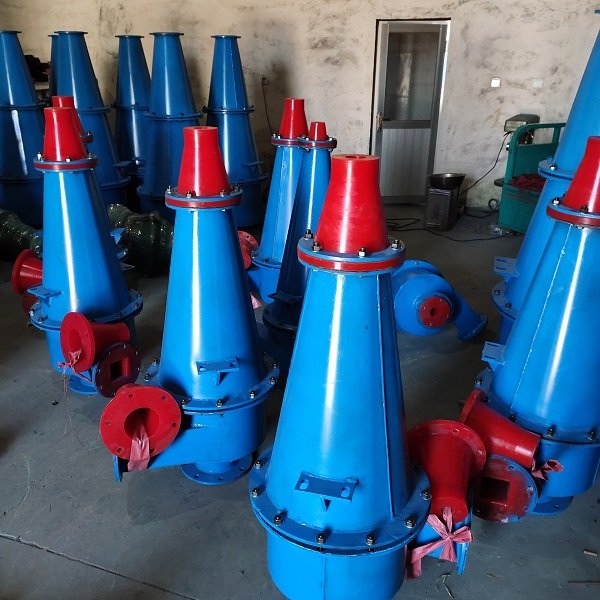
Hydrocyclone Filter Applications
Hydrocyclone filters are widely used in mineral processing operations at both ferrous and non-ferrous metal mines. In unit operations such as closed-circuit grinding and classification, tailings backfilling and dam construction, slurry thickening and clarification, and open-circuit classification—across mines producing iron, copper, gold, and nickel—they have improved metal recovery rates, increased hourly processing capacity, and enhanced the economic efficiency of processing plants.
Technical Parameters of Hydrocyclone Filter
| Mode | Diameter (mm) | Feed Port (mm) | Overflow Port Diameter (mm) | Desanding Port Diameter (mm) | Angle of Inclination (°) | Max Feed Size (mm) | Feed Pressure (MPa) | Capacity (m³/h) | Separation Size (µm) | Overall Dimensions (mm) |
| FX-660
|
660
|
187 167
|
180.2 | 80 | 20
|
16
|
0.03-0.4
|
250-360
|
74-220
|
1215×850×2720
|
| 220,240 | 110,150 | |||||||||
| FX-500
|
500
|
130 120
|
130,140,160, 80,220
|
35,45,50 | 25 | 10
|
0.03-0.4
|
140-220
|
74-200 | 951×718×1825 |
| 65,70,80 | 20 | 74-200 | 850×623×1825 | |||||||
| 90,100 | 10 | 74-150 | 951×718×2280 | |||||||
| FX-350
|
350
|
80 | 80,90,105, 115,120 | 30,35,40 45,50,60,70
|
25 | 6
|
0.03-0.4
|
60-105
|
50-150 | 530×413×1411 |
| 20 | 50-150 | 530×413×1411 | ||||||||
| 15 | 50-120 | 530×413×1674 | ||||||||
| FX-300 | 300 | 64 75 | 65,80, 100,120 | 20,25, | 20 | 5 | 0.03-0.4 | 45-90 | 50-150 | 530×410×1305 |
| 30,35,40 | 15 | 40-100 | 563×410×1490 | |||||||
| FX-250 | 250 | 55 74 80 | 60,75, 80,100,120 | 25,30,35,40 | 20 | 3 | 0.05-0.4 | 40-65 | 40-100 | 563×534×1178 |
| 15 | 40-100 | 548×390×1057 | ||||||||
| 10 | 30-100 | 548×415×1380 | ||||||||
| FX-200 | 200 | 48 | 40,45, 55,65 | 16,20, | 20 | 2 | 0.05-0.4 | 25-40 | 40-100 | 548×307×1025 |
| 24,28,32 | 15 | 30-100 | 320×307×1114 | |||||||
| FX-150 | 150 | 36 | 30,35, 40,45 | 8,10,12,14,16, 18,20,22 | 20 | 1.5 | 0.05-0.4 | 11-20.0 | 30-74 | 320×270×682 |
| 15 | 30-74 | 252×349×899 | ||||||||
| 8 | 20-74 | 290×295×1267 | ||||||||
| FX-125 | 125 | 26 | 25,30, 35,40 | 8,10,12,14,16, 18,20,22 | 17 | 1 | 0.05-0.4 | 8-15.0 | 20-100 | 280×185×617 |
| 8 | 20-74 | 210×240×973 | ||||||||
| FX-100 | 10 | 23 | 20,25, 30,40 | 8,10,12,14,16, 18,20,22 | 20 | 1 | 0.05-0.4 | 5-12.0 | 20-100 | 250×210×525 |
| 15 | 10-100 | 257×210×575 | ||||||||
| 8 | 10-74 | 257×210×829 |


Related products
-
Hydrocyclone Separator
Hydrocyclone separators are used in ferrous and non-ferrous metal mines for grinding and classification, thickening, dewatering, desliming, and ultrafine classification, as well as for tailings backfilling, dam construction, and recovery.
- Capacity: 5 – 360 m³/h
- Feed Size: ≤ 16 mm
- Separation Size: 10 – 220 μm
-
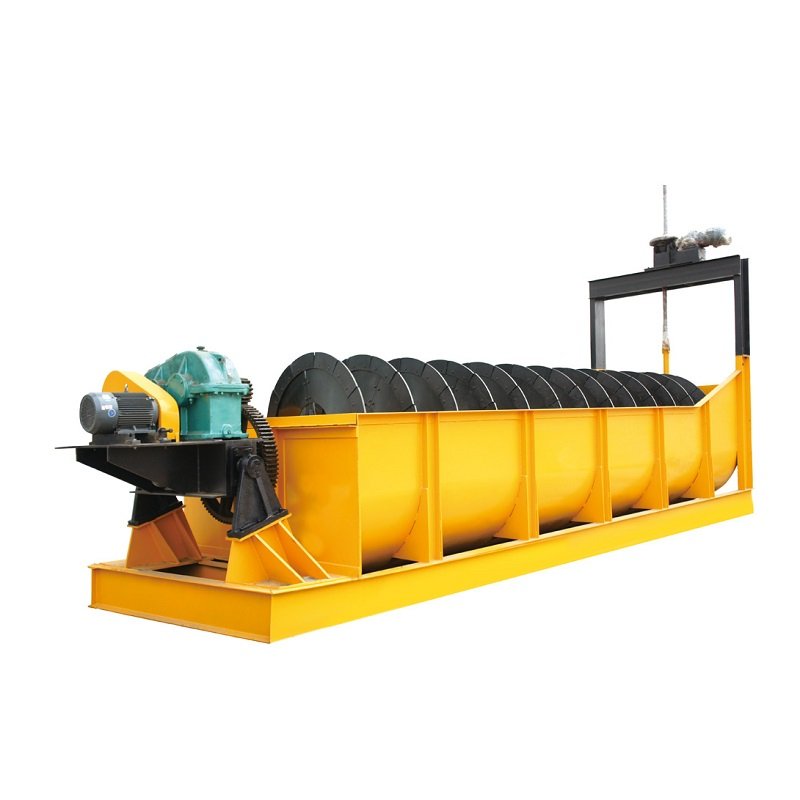
Spiral Classifier Machine
Spiral classifier machines are widely used for classification in the grinding circuits of mineral processing plants, as well as for ore washing, desliming, and dewatering operations. Their primary advantages include simple construction, reliable performance, and ease of operation.
- Capacity: sand return rate: 135–23300 t/d; overflow rate: 32 – 1410 t/d
- Feed Size: ≤ 0.15 mm
- Spiral diameter: 500- 3000 mm
-
Spiral Classifier Equipment
Spiral classifier equipment is primarily used in grinding circuits for preliminary and check classification, as well as in sand and gravel aggregate processing for desliming and dewatering.
- Capacity: sand return rate: 135–23300 t/d; overflow rate: 32 – 1410 t/d
- Feed Size: ≤ 0.15 mm
- Spiral diameter: 500- 3000 mm
-
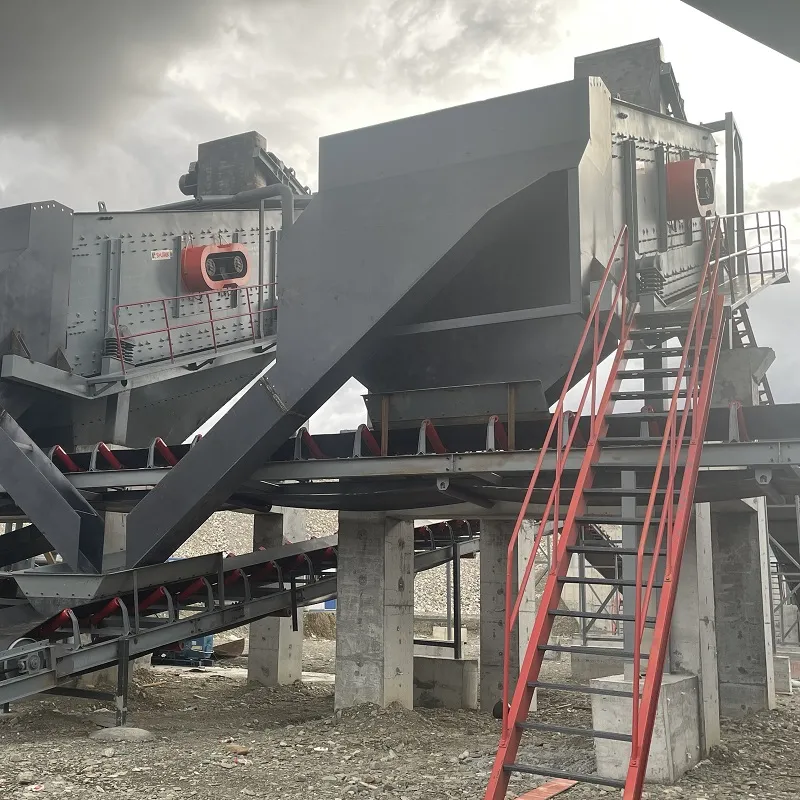
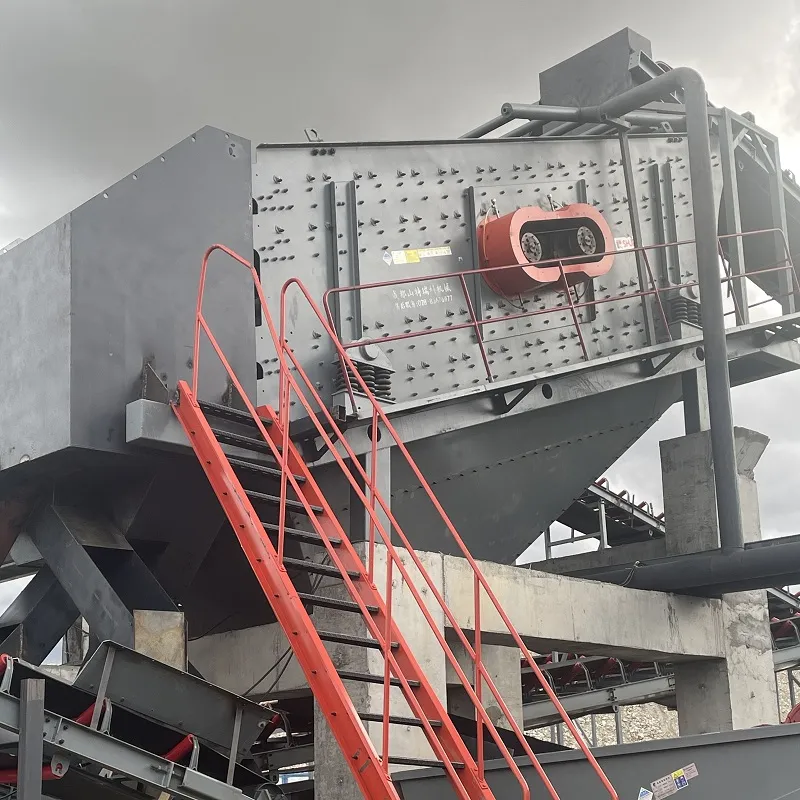
Mining Vibrating Screens
Mining vibrating screens are widely used in the mining and construction industries, particularly for screening coarse-grained materials. They offer advantages such as a high-strength screen frame, a well-designed mechanical structure, low operating temperatures for large-clearance bearings, low noise levels, and a long service life.
- Capacity: 70 – 500 t/h
- Feed Size: ≤ 250 mm
- Screen Mesh: < 100 mm
-
Industrial Vibrating Screens
This industrial vibrating screen operates with a circular motion. This new multi-deck vibrating screen is designed specifically for screening stone in quarries. It is also suitable for product classification in sectors such as coal preparation, mineral processing, construction materials, electric power, and the chemical industry.
- Capacity: 70 – 500 t/h
- Feed Size: ≤ 250 mm
- Screen Mesh: < 100 mm